
English Diagnostic Test & Remedial Teaching
B.Ed. / D.El.Ed. विद्यार्थियों के लिए सम्पूर्ण english diagnostic test & remedial teaching प्रैक्टिकल फाइल (30 Topics) + 🆓 Free PDF Download.

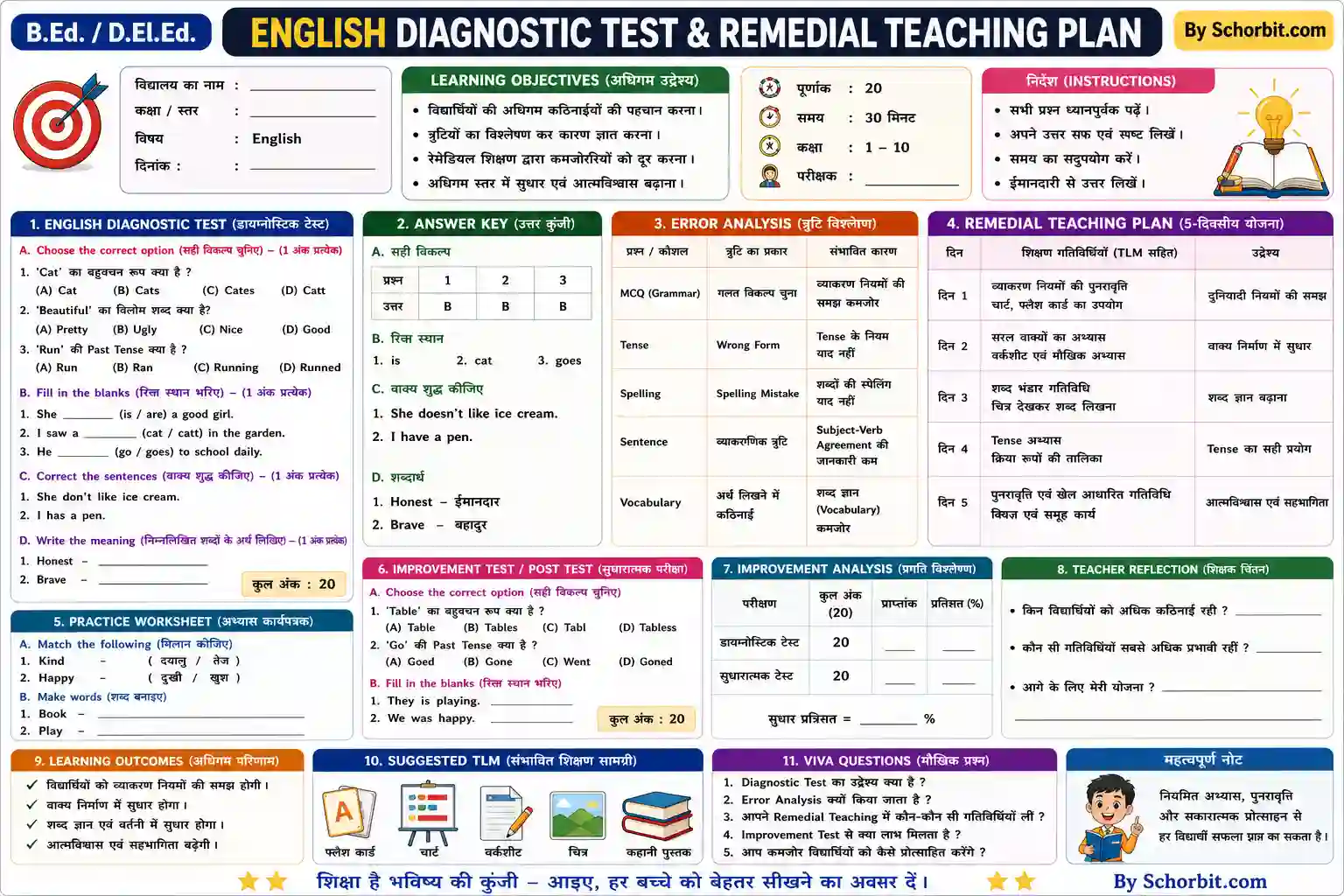
B.Ed D.El.Ed English Diagnostic Test & Remedial Teaching प्रैक्टिकल फाइल के लिए केवल Question Paper होना ही पर्याप्त नहीं है। एक आदर्श फाइल में पूरी Diagnostic Process (निदानात्मक प्रक्रिया) and remedial teaching (उपचारात्मक शिक्षण) होनी चाहिए।
इस पेज पर हमारे विषय विशेषज्ञों (Specialist Teachers) की टीम द्वारा English (अंग्रेज़ी) विषय के 30 सबसे महत्वपूर्ण Topics पर सम्पूर्ण, 100% Solved प्रैक्टिकल फाइल्स तैयार की गई हैं। यह सामग्री english diagnostic test & remedial teaching के लिए इंटरनेट पर उपलब्ध सबसे प्रामाणिक और सर्वश्रेष्ठ गाइड है।
प्रत्येक टॉपिक (Topic) को एक अत्यंत विस्तृत 12-बिंदुओं वाले प्रारूप (12-Point Structure) में प्रस्तुत किया गया है, जो कि बाह्य परीक्षक (External Examiner) की सभी आवश्यकताओं को पूरा करता है:
- 1. छात्र रूपरेखा (Student Profile)
- 2. अधिगम उद्देश्य (Learning Objectives)
- 3. निदानात्मक परीक्षण पत्र (Diagnostic Test Paper – 20 Marks)
- 4. उत्तर कुंजी (Answer Key)
- 5. परिणाम विश्लेषण (Result Analysis)
- 6. त्रुटि विश्लेषण (Error Analysis Table)
- 7. व्यावहारिक समस्या खंड (Analytical Word Problems Block)
- 8. 5-दिवसीय उपचारात्मक शिक्षण योजना (Remedial Teaching Plan)
- 9. उपचारात्मक कार्यपत्रक (Remedial Worksheet)
- 10. पॉस्ट-टेस्ट मूल्यांकन (Post Test Assessment)
- 11. सुधार रिपोर्ट (Improvement Report Card)
- 12. शिक्षक आत्म-चिन्तन (Teacher Reflection)
इसके साथ ही, आप पेज अंत (Download Section) से सम्पूर्ण 100% Solved PDF File और Internship के लिए 50+ Important Viva Questions की PDF भी बिल्कुल फ्री में डाउनलोड कर सकते हैं। नीचे दी गई सूची में से अपना टॉपिक चुनें:
D.El.Ed / BSTC छात्रों के लिए विशेष सूचना Important
क्या आप D.El.Ed या BSTC इंटर्नशिप कर रहे हैं? आप हमारी वेबसाइट से सभी विषयों (हिंदी, अंग्रेजी, गणित, पर्यावरण आदि) की Daily Lesson Plan (दैनिक पाठ योजना) डायरी की सम्पूर्ण PDF मुफ्त में डाउनलोड कर सकते हैं।
👉 सभी विषयों के Lesson Plans यहाँ से डाउनलोड करें📑 Table of Contents
📚 All Topics
📥 Important Links
📚 सभी विषयों के B.Ed Lesson Plans (नि:शुल्क डाउनलोड करें)
📘 Topic 1: Parts of Speech Overview (Noun, Pronoun, Verb, Adjective etc.) – For Class Class 6 to 8 (Elementary Level)
1. छात्र रूपरेखा (Student Profile)
| विद्यालय का नाम: | Government Senior Secondary School, Jaipur | कक्षा (Target Class): | Class 6 to 8 (Elementary Level) |
| परीक्षण के लिए चयनित छात्र: | 20 Students | परीक्षण की प्रकृति: | Categorization, Identification, and Functional Application of Words. |
2. अधिगम उद्देश्य (Learning Objectives)
- To enable students to identify different parts of speech in a given sentence.
- To help students understand the functional role of words rather than just their definitions.
- To eliminate confusion between adjectives and adverbs.
- To build the ability to construct meaningful sentences using correct word forms.
3. निदानात्मक परीक्षण पत्र (Diagnostic Test Paper – 20 Marks)
निर्देश (Instructions): सभी प्रश्न अनिवार्य हैं। प्रत्येक प्रश्न के सम्मुख उसके अंक अंकित हैं।
Section ‘A’ — Word Categorization — [10 Marks]
(i) She runs fast. → [ ]
(ii) The fast train just left. → [ ]
(iii) Muslims fast during Ramadan. → [ ]
Q2. Match the words with their correct part of speech: (4 Marks)
(a) Happiness → (i) Adjective
(b) Beautiful → (ii) Noun
(c) Quickly → (iii) Conjunction
(d) Because → (iv) Adverb
Q3. Fill in the blanks with suitable pronouns: (3 Marks)
(a) Ram is a good boy. _______ obeys his teachers.
(b) The dog bit _______ tail.
(c) _______ is your name?
Section ‘B’ — Applied Usage — [10 Marks]
(i) He speaks English (fluent/fluently).
(ii) She looks (beautiful/beautifully).
Q5. Form Nouns from the following words: (4 Marks)
(a) Educate → _______
(b) Honest → _______
(c) Dark → _______
(d) Grow → _______
4. उत्तर कुंजी (Answer Key)
q1: Q1: (i) Adverb, (ii) Adjective, (iii) Verb
q2: Q2: (a)-(ii), (b)-(i), (c)-(iv), (d)-(iii)
q3: Q3: (a) He, (b) its, (c) What
q4: Q4: (i) fluently, (ii) beautiful
q5: Q5: (a) Education, (b) Honesty, (c) Darkness, (d) Growth
5. परिणाम विश्लेषण (Result Analysis)
परीक्षण के बाद 20 छात्रों के प्राप्तांकों का विश्लेषण करके उन्हें तीन श्रेणियों में विभाजित किया गया:
| श्रेणी (Category) | प्राप्तांक का दायरा | छात्रों की संख्या | अधिगम स्तर की स्थिति |
|---|---|---|---|
| Group – A (Advanced) | 16 to 20 Marks | 05 Students | Clear understanding of word functions. |
| Group – B (Intermediate) | 11 to 15 Marks | 08 Students | Can identify basic nouns and verbs but struggles with adverbs vs adjectives. |
| Group – C (Critical Gap) | 10 Marks or less | 07 Students | Mixes up functional roles; relies on rote memorization of definitions. |
6. त्रुटि विश्लेषण (Error Analysis Table)
| अशुद्ध तथ्य/धारणा (Student’s Error) | शुद्ध तथ्य (Correct Fact) | त्रुटि का प्रकार (Nature of Error) | कारण (Cause) |
|---|---|---|---|
| Saying ‘fast’ is always an adjective. | The function determines the part of speech, not the word itself. | Rigid Memorization | Students learn word lists instead of analyzing sentence structure. |
| Writing ‘She looks beautifully’. | Verbs of sensation (look, feel, taste) take adjectives, not adverbs. ‘She looks beautiful’. | Over-generalization of -ly rule | Assuming all action modifiers end in -ly without knowing exceptions for sensory verbs. |
7. Analytical Word Problems Block (व्यावहारिक समस्या खंड)
| The Core Student Problem | Our Step-by-Step Remedial Solution |
|---|---|
| The “Action-Only” Verb Myth: Students think verbs only represent physical actions (run, jump) and fail to identify ‘is’, ‘am’, ‘are’, ‘have’ as verbs. | The ‘State of Being’ Crown: Introduce helping and stative verbs as ‘invisible actions’ or ‘state crowns’ that hold the sentence together. |
| Adjective-Adverb Confusion: Modifying the noun vs modifying the action. | The ‘Arrow Drawing’ Method: Ask students to draw an arrow from the describing word to the word it describes. If the arrow hits a noun, it’s an Adjective. If it hits a verb, it’s an Adverb. |
8. 5-दिवसीय उपचारात्मक शिक्षण योजना (Remedial Teaching Plan)
उपचारात्मक समूह: Target Group: Group-C (07 Students)
शिक्षण सहायक सामग्री (TLM): Teaching Aids (TLM): Function Arrow Cards, Parts of Speech Sorting Bins, Sensory Verb Chart.
| दिन (Day) | समय | शिक्षण गतिविधि (Teaching Activity) |
|---|---|---|
| Day 1 | 40 Mins | The Word Function Sorting Game Provide sentences where the same word acts as a Noun and a Verb. Students sort them into functional bins. |
| Day 2 | 40 Mins | Arrow Drawing Method Students physically draw arrows connecting modifiers to their targets to visually deduce the part of speech. |
| Day 3 | 40 Mins | Sensory Exceptions Taste, look, feel activity with real objects to cement why we say ‘tastes good’ not ‘tastes well’. |
9. उपचारात्मक कार्यपत्रक (Remedial Worksheet)
छात्र अभ्यास हेतु (For Student Practice):
Q2. Use ‘water’ as a Noun in one sentence and as a Verb in another.
10. पॉस्ट-टेस्ट मूल्यांकन (Post Test Assessment)
After implementing the sorting bins and arrow methods, a post-test showed significant improvement in functional identification.
11. सुधार रिपोर्ट (Improvement Report Card)
| छात्र का नाम/कोड | प्री-टेस्ट | पॉस्ट-टेस्ट | ग्राफ़ (Progress) | वास्तविक सुधार स्थिति (Remarks) |
|---|---|---|---|---|
| Student 02 (Class 6) | 04 / 20 | 14 / 20 | 🔴 Pre | 🟢 Post | Mastered the arrow method to correctly distinguish adverbs from adjectives. |
12. शिक्षक आत्म-चिन्तन (Teacher Reflection)
शिक्षक की डायरी से स्व-मूल्यांकन:
“Teaching grammar through rigid definitions creates robots. By focusing on word functions and using tactile methods like arrows and bins, abstract concepts became concrete.”
* This section is a part of the complete B.Ed/D.El.Ed English Diagnostic Test & Remedial Teaching internship diary.
📘 Topic 2: Tense Chart & Correct Form of Verbs – For Class Class 6 to 8 (Elementary Level)
1. छात्र रूपरेखा (Student Profile)
| विद्यालय का नाम: | Government Senior Secondary School, Jaipur | कक्षा (Target Class): | Class 6 to 8 (Elementary Level) |
| परीक्षण के लिए चयनित छात्र: | 20 Students | परीक्षण की प्रकृति: | Error Identification, Sentence Correction, and Gap-Filling using Time-Markers (Keywords). |
2. अधिगम उद्देश्य (Learning Objectives)
- To enable students to identify different time-markers (e.g., always, yesterday, tomorrow, since) and map them to the correct tense.
- To help students master the structural syntax of Indefinite, Continuous, and Perfect tenses.
- To eliminate structural spelling errors when adding suffixes like -ed or -ing to base verbs.
- To build the ability to write grammatically correct sentences for real-world English communication.
3. निदानात्मक परीक्षण पत्र (Diagnostic Test Paper – 20 Marks)
निर्देश (Instructions): सभी प्रश्न अनिवार्य हैं। प्रत्येक प्रश्न के सम्मुख उसके अंक अंकित हैं।
Section ‘A’ — Structural & Keyword Mapping — [10 Marks]
(i) My mother always ____________ tasty food for us.
(a) cook (b) cooks (c) cooking (d) cooked → [ ]
(ii) They ____________ football in the park yesterday.
(a) play (b) are playing (c) played (d) will play → [ ]
Q2. Fill in the blanks with the correct form of the verb given in brackets: (3 × 1 = 3 Marks)
(a) She ____________ (live) in Jaipur since 2018. (Hint: Check time duration)
(b) Water ____________ (boil) at 100°C. (Scientific Fact)
Q3. Identify the Tense of the given sentences: (4 × 1 = 4 Marks)
(a) I have seen the Taj Mahal twice. → ____________________
(b) Tomorrow at this time, we will be travelling to Delhi. → ____________________
Section ‘B’ — Applied Grammar & Error Rectification — [10 Marks]
(i) She did not went to school last Monday. → ____________________
(ii) Ram is knowing my brother very well. → ____________________
Q5. Sentence Transformation: Change as directed: (4 Marks)
(a) “They write a letter.” → (Change into Present Perfect Negative)
(b) “He was driving a car.” → (Change into Interrogative)
4. उत्तर कुंजी (Answer Key)
q1: Q1: (i) b (cooks – due to ‘always’), (ii) c (played – due to ‘yesterday’)
q2: Q2: (a) has been living, (b) boils
q3: Q3: (a) Present Perfect Tense, (b) Future Continuous Tense.
q4: Q4: (i) did not go (After ‘did’, base form V1 is used), (ii) knows (‘Know’ is a stative verb).
q5: Q5: (a) They have not written a letter, (b) Was he driving a car?
5. परिणाम विश्लेषण (Result Analysis)
परीक्षण के बाद 20 छात्रों के प्राप्तांकों का विश्लेषण करके उन्हें तीन श्रेणियों में विभाजित किया गया:
| श्रेणी (Category) | प्राप्तांक का दायरा | छात्रों की संख्या | अधिगम स्तर की स्थिति |
|---|---|---|---|
| Group – A (Advanced) | 16 to 20 Marks | 04 Students | Clear understanding of time-markers, structure, and exceptions. |
| Group – B (Intermediate) | 11 to 15 Marks | 07 Students | Understands basic tenses, but struggles with complex structures like Past Perfect. |
| Group – C (Critical Gap) | 10 Marks or less | 09 Students | Mixes up helping verbs, applies double past tense, and lacks keyword mapping. |
6. त्रुटि विश्लेषण (Error Analysis Table)
| अशुद्ध तथ्य/धारणा (Student’s Error) | शुद्ध तथ्य (Correct Fact) | त्रुटि का प्रकार (Nature of Error) | कारण (Cause) |
|---|---|---|---|
| Writing “did not went” or “did you played?” | ‘Did’ is already in the past form; it is always followed by the base form of the verb (V1). E.g., “did not go”. | Over-correction / Double Past Mark | The student over-generalizes that every past sentence must have regular -ed or V2 verbs everywhere. |
| Mixing “Since” and “For” | Since = Point of time. For = Duration/Length of time. | Conceptual Confusion | Inability to distinguish between a fixed starting point and a calculated duration. |
7. Analytical Word Problems Block (व्यावहारिक समस्या खंड)
| The Core Student Problem | Our Step-by-Step Remedial Solution |
|---|---|
| The Translation Trap (L1 Interference): Students translate directly from Hindi to English. For example, “मैं दो घंटे से खेल रहा हूँ” becomes “I am playing since two hours.” | The “Time-Stretch” Visualization Tool: Instead of translating words, show them that an action starting in the past and still running requires a special bridge: Has/Have + Been. |
| Stative Verb Blind Spot: Students write “I am loving this food” or “He is owning a big house” because it sounds natural in continuous mode. | “Actions vs Feelings” Filtering Card: Teach them the “CCTV Test”. If an action can be physically captured on a CCTV camera, it can take -ing. If it is a mental state or possession, it stays in the Simple form. |
8. 5-दिवसीय उपचारात्मक शिक्षण योजना (Remedial Teaching Plan)
उपचारात्मक समूह: Target Group: Group-C (09 Students)
शिक्षण सहायक सामग्री (TLM): Teaching Aids (TLM): Tense Anchor Chart, Keyword Flashcards, Formula Sliding Strips.
| दिन (Day) | समय | शिक्षण गतिविधि (Teaching Activity) |
|---|---|---|
| Day 1 | 40 Mins | The Keyword Detective Game (Time Markers) Instead of formulas, students are given sentences with highlighted clues. They learn to act as detectives to declare the tense just by looking at the clue card. |
| Day 2 | 40 Mins | Breaking the ‘Double Past’ Habit Using a physical puppet named ‘Captain Did’, students are shown that ‘Did’ eats up the past power of the main verb. |
| Day 3 | 40 Mins | The Point vs Period Timeline Activity Draw a giant line on the floor. One side is ‘Point’ (Since) and the other is ‘Box of Time’ (For). |
9. उपचारात्मक कार्यपत्रक (Remedial Worksheet)
छात्र अभ्यास हेतु (For Student Practice):
(a) He do not like to drink milk in the morning. → ____________
(b) We have walked for five miles since morning. → ____________
Q2. Gap-filling with correct suffix rules:
(i) The baby has been ____________ (cry) for an hour.
(ii) They ____________ (buy) a new car next month.
10. पॉस्ट-टेस्ट मूल्यांकन (Post Test Assessment)
After implementing the 5-day timeline games and dynamic suffix workshops, an equivalent 20-mark post-test was administered. Evaluation Result: The habit of using “did + V2” dropped to zero. All 09 weak students scored 14+ marks out of 20.
11. सुधार रिपोर्ट (Improvement Report Card)
| छात्र का नाम/कोड | प्री-टेस्ट | पॉस्ट-टेस्ट | ग्राफ़ (Progress) | वास्तविक सुधार स्थिति (Remarks) |
|---|---|---|---|---|
| Student 04 (Class 7) | 03 / 20 | 16 / 20 | 🔴 Pre | 🟢 Post | Eliminated ‘did + past verb’ errors; syntax structure is well-aligned now. |
| Student 09 (Class 6) | 05 / 20 | 15 / 20 | 🔴 Pre | 🟢 Post | Correctly identifies and uses time-markers for Present Continuous. |
12. शिक्षक आत्म-चिन्तन (Teacher Reflection)
शिक्षक की डायरी से स्व-मूल्यांकन:
“”Teaching tenses by making kids memorize the giant definitions of ‘Ta, Te, Ti’ or complex formula tables often fails. By shifting the pedagogical focus to visual time-markers and treating structural errors like ‘did + went’ as logical gaps rather than just mistakes, students adapted to self-correction rapidly.””
* This section is a part of the complete B.Ed/D.El.Ed English Diagnostic Test & Remedial Teaching internship diary.
📘 Topic 3: Active and Passive Voice Conversion – For Class Class 7 to 8 (Elementary Level)
B.Ed / D.El.Ed Internship Hub
सम्पूर्ण इंटर्नशिप की सभी डायरियों, लेसन प्लान्स और फाइलों का One-Stop Hub। यहाँ से सब कुछ एक ही जगह पर मिलेगा।
B.Ed Daily Lesson Plan Diary
दैनिक पाठ योजना डायरी: 15-20 सप्ताह की इंटर्नशिप के दौरान प्रतिदिन पढ़ाई जाने वाली पाठ योजनाओं (Lesson Plans) का सम्पूर्ण हल।
1. छात्र रूपरेखा (Student Profile)
| विद्यालय का नाम: | Government Senior Secondary School, Jaipur | कक्षा (Target Class): | Class 7 to 8 (Elementary Level) |
| परीक्षण के लिए चयनित छात्र: | 20 Students | परीक्षण की प्रकृति: | Subject-Object Swapping, Verb Form Adjustments, and Syntax Structuring. |
2. अधिगम उद्देश्य (Learning Objectives)
- To enable students to identify the Subject, Verb, and Object (SVO) in an active sentence.
- To help students master the rule of swapping Subject and Object.
- To ensure students can accurately change the main verb to its V3 (past participle) form and select the correct helping verb.
- To build practical understanding of when to use passive voice in real-world contexts.
3. निदानात्मक परीक्षण पत्र (Diagnostic Test Paper – 20 Marks)
निर्देश (Instructions): सभी प्रश्न अनिवार्य हैं। प्रत्येक प्रश्न के सम्मुख उसके अंक अंकित हैं।
Section ‘A’ — S-V-O Identification & Basic Swap — [10 Marks]
(i) The dog chased the cat.
(ii) She sings a beautiful song.
Q2. Change the following sentences to Passive Voice: (6 Marks)
(a) Ram writes a letter.
(b) The teacher punished the boys.
(c) They are playing cricket.
Q3. Correct the error in these passive sentences: (4 Marks)
(i) A letter is wrote by him.
(ii) The work has finished by me.
Section ‘B’ — Advanced Structures — [10 Marks]
(a) Open the door.
(b) You must follow the rules.
(c) Who wrote this book?
4. उत्तर कुंजी (Answer Key)
q1: Q1: (i) S: The dog, V: chased, O: the cat. (ii) S: She, V: sings, O: a beautiful song.
q2: Q2: (a) A letter is written by Ram. (b) The boys were punished by the teacher. (c) Cricket is being played by them.
q3: Q3: (i) A letter is written by him (V3 must be used). (ii) The work has been finished by me.
q4: Q4: (a) Let the door be opened. (b) The rules must be followed by you. (c) By whom was this book written?
5. परिणाम विश्लेषण (Result Analysis)
परीक्षण के बाद 20 छात्रों के प्राप्तांकों का विश्लेषण करके उन्हें तीन श्रेणियों में विभाजित किया गया:
| श्रेणी (Category) | प्राप्तांक का दायरा | छात्रों की संख्या | अधिगम स्तर की स्थिति |
|---|---|---|---|
| Group – A (Advanced) | 16 to 20 Marks | 06 Students | Adept at SVO parsing and modal passive conversions. |
| Group – B (Intermediate) | 11 to 15 Marks | 06 Students | Can swap S-O, but struggles with continuous and perfect tense helping verbs. |
| Group – C (Critical Gap) | 10 Marks or less | 08 Students | Fails to identify the object correctly; forgets to use V3. |
6. त्रुटि विश्लेषण (Error Analysis Table)
| अशुद्ध तथ्य/धारणा (Student’s Error) | शुद्ध तथ्य (Correct Fact) | त्रुटि का प्रकार (Nature of Error) | कारण (Cause) |
|---|---|---|---|
| Writing ‘A letter is wrote by him’. | Passive voice strictly uses the 3rd form of the verb (V3). ‘written’. | Verb Form Error | Student does not remember irregular V3 forms and relies on V2. |
| Writing ‘Cricket is playing by them’. | ‘Cricket is being played by them’. | Missing Continuous Helper | Failure to insert ‘being’ to preserve the ‘-ing’ continuous aspect of the original sentence. |
7. Analytical Word Problems Block (व्यावहारिक समस्या खंड)
| The Core Student Problem | Our Step-by-Step Remedial Solution |
|---|---|
| The “Long Object” Trap: Students grab only the last word of a sentence as the object instead of the whole noun phrase (e.g., ‘a beautiful song’). | The ‘What/Whom’ Net: Teach students to throw a ‘What’ or ‘Whom’ question at the verb. The entire answer they catch is the true object block to move. |
| V3 Amnesia: Students default to V2 because they forget the V3 form. | The ‘Passive Filter’: Reinforce that the Passive Machine only outputs V3. Give them a pocket chart of top 50 irregular verbs. |
8. 5-दिवसीय उपचारात्मक शिक्षण योजना (Remedial Teaching Plan)
उपचारात्मक समूह: Target Group: Group-C (08 Students)
शिक्षण सहायक सामग्री (TLM): Teaching Aids (TLM): Subject-Object Swap Flashcards, ‘Being/Been’ Sticky Notes, V3 Pocket Chart.
| दिन (Day) | समय | शिक्षण गतिविधि (Teaching Activity) |
|---|---|---|
| Day 1 | 40 Mins | The SVO Swapping Physical Game Three students hold placards (S, V, O). They physically walk to swap places, and a fourth student adds the ‘By’ placard. |
| Day 2 | 40 Mins | The ‘What/Whom’ Net Catching Practice extracting full objects using the ‘What/Whom’ questioning technique to prevent breaking phrases. |
| Day 3 | 40 Mins | The ‘Being/Been’ Bridge Focus exclusively on Continuous (‘ing’ to ‘being’) and Perfect (‘has’ to ‘has been’) tense passive adjustments. |
9. उपचारात्मक कार्यपत्रक (Remedial Worksheet)
छात्र अभ्यास हेतु (For Student Practice):
Q2. Convert to passive, ensuring you use V3: ‘She is singing a song.’
10. पॉस्ट-टेस्ट मूल्यांकन (Post Test Assessment)
In the follow-up assessment, 7 out of 8 weak students successfully applied the ‘What/Whom’ net to correctly identify long objects and used V3 forms.
11. सुधार रिपोर्ट (Improvement Report Card)
| छात्र का नाम/कोड | प्री-टेस्ट | पॉस्ट-टेस्ट | ग्राफ़ (Progress) | वास्तविक सुधार स्थिति (Remarks) |
|---|---|---|---|---|
| Student 12 (Class 8) | 06 / 20 | 17 / 20 | 🔴 Pre | 🟢 Post | Mastered continuous and perfect passive constructions using ‘being’ and ‘been’. |
12. शिक्षक आत्म-चिन्तन (Teacher Reflection)
शिक्षक की डायरी से स्व-मूल्यांकन:
“Turning sentence structure into a physical swapping game helped kinesthetic learners immensely. Abstractions like ‘Subject’ and ‘Object’ made sense once they became physical roles.”
* This section is a part of the complete B.Ed/D.El.Ed English Diagnostic Test & Remedial Teaching internship diary.
📘 Topic 4: Direct and Indirect Speech (Narration) – For Class Class 7 to 8 (Elementary Level)
1. छात्र रूपरेखा (Student Profile)
| विद्यालय का नाम: | Government Senior Secondary School, Jaipur | कक्षा (Target Class): | Class 7 to 8 (Elementary Level) |
| परीक्षण के लिए चयनित छात्र: | 20 Students | परीक्षण की प्रकृति: | Pronoun Change, Tense Backshifting, and Reporting Verb Adjustments. |
2. अधिगम उद्देश्य (Learning Objectives)
- To understand the difference between the reporting verb and reported speech.
- To apply the SON (Subject-Object-No change) formula for pronoun shifting.
- To correctly backshift tenses when the reporting verb is in the past.
- To adjust time and place markers (e.g., today to that day).
3. निदानात्मक परीक्षण पत्र (Diagnostic Test Paper – 20 Marks)
निर्देश (Instructions): सभी प्रश्न अनिवार्य हैं। प्रत्येक प्रश्न के सम्मुख उसके अंक अंकित हैं।
Section ‘A’ — Pronoun & Time Changes — [10 Marks]
(a) Now → (i) The next day
(b) Today → (ii) Then
(c) Tomorrow → (iii) That day
(d) Here → (iv) There
Q2. Change the pronouns using the SON rule (Do not change tense): (6 Marks)
(a) He says to me, “I am your friend.”
(b) She says, “I do my work myself.”
Q3. Change into Indirect Speech (Assertive & Interrogative): (6 Marks)
(a) Ram said to Shyam, “I am reading a book.”
(b) The teacher said, “The sun rises in the east.”
(c) He said to me, “Are you going to school?”
Section ‘B’ — Full Sentence Conversions — [10 Marks]
(i) He asked me that where I was going.
(ii) She told me that she will come tomorrow.
4. उत्तर कुंजी (Answer Key)
q1: Q1: (a)-(ii), (b)-(iii), (c)-(i), (d)-(iv)
q2: Q2: (a) He tells me that he is my friend. (b) She says that she does her work herself.
q3: Q3: (a) Ram told Shyam that he was reading a book. (b) The teacher said that the sun rises in the east. (c) He asked me if I was going to school.
q4: Q4: (i) He asked me where I was going (No ‘that’ with WH words). (ii) She told me that she would come the next day.
5. परिणाम विश्लेषण (Result Analysis)
परीक्षण के बाद 20 छात्रों के प्राप्तांकों का विश्लेषण करके उन्हें तीन श्रेणियों में विभाजित किया गया:
| श्रेणी (Category) | प्राप्तांक का दायरा | छात्रों की संख्या | अधिगम स्तर की स्थिति |
|---|---|---|---|
| Group – A (Advanced) | 16 to 20 Marks | 04 Students | Proficient in backshifting, pronoun changes, and exception handling (universal truths). |
| Group – B (Intermediate) | 11 to 15 Marks | 09 Students | Can change assertive sentences but struggles with interrogatives (using ‘if/whether’ vs WH-words). |
| Group – C (Critical Gap) | 10 Marks or less | 07 Students | Severe confusion with pronoun changes; fails to backshift tense. |
6. त्रुटि विश्लेषण (Error Analysis Table)
| अशुद्ध तथ्य/धारणा (Student’s Error) | शुद्ध तथ्य (Correct Fact) | त्रुटि का प्रकार (Nature of Error) | कारण (Cause) |
|---|---|---|---|
| Writing ‘He asked me that where I was going.’ | In WH-questions, the WH-word acts as the conjunction. ‘That’ is never used. | Double Conjunction Error | Over-applying the rule that ‘that’ must join all reported speech sentences. |
| Writing ‘Ram told Shyam that I was reading a book.’ | ‘I’ changes to ‘he’ according to the speaker (Ram). | Pronoun Mapping Failure | Student ignores the SON rule and keeps the direct pronoun intact. |
7. Analytical Word Problems Block (व्यावहारिक समस्या खंड)
| The Core Student Problem | Our Step-by-Step Remedial Solution |
|---|---|
| The Pronoun Maze: Students lose track of who is talking to whom, mixing up ‘I’, ‘He’, ‘You’, and ‘Me’. | The SON Formula Decoder: Teach the 123/SON rule (1st person changes to Subject, 2nd to Object, 3rd No Change) with colored highlighters mapping the pronoun to the speaker/listener. |
| The Universal Truth Trap: Students blindly backshift everything, changing ‘The sun rises’ to ‘The sun rose’. | The ‘Fact Check’ Stop Sign: Teach them to pause before changing tenses and ask, ‘Is this a universal fact or routine?’. If yes, no tense change. |
8. 5-दिवसीय उपचारात्मक शिक्षण योजना (Remedial Teaching Plan)
उपचारात्मक समूह: Target Group: Group-C (07 Students)
शिक्षण सहायक सामग्री (TLM): Teaching Aids (TLM): SON Rule Highlighters, Direct/Indirect Conversion Wheel, ‘Fact Check’ Stop Sign.
| दिन (Day) | समय | शिक्षण गतिविधि (Teaching Activity) |
|---|---|---|
| Day 1 | 40 Mins | Mastering the SON Decoder Using colored markers to map pronouns inside quotes to the speaker/listener outside the quotes. |
| Day 2 | 40 Mins | Tense Backshifting Engine Visualizing tense changes as stepping down one floor on an elevator (Present to Past, Past to Past Perfect). |
| Day 3 | 40 Mins | Interrogative Gatekeepers (If vs WH) Learning when to use ‘if/whether’ (for Yes/No questions) and when to use the WH-word as the glue. |
9. उपचारात्मक कार्यपत्रक (Remedial Worksheet)
छात्र अभ्यास हेतु (For Student Practice):
Q2. Change to indirect speech without changing the tense (Universal Fact): The teacher said, ‘Water freezes at 0 degrees.’
10. पॉस्ट-टेस्ट मूल्यांकन (Post Test Assessment)
Post-remediation, students successfully stopped using ‘that’ with WH-questions and applied the SON rule accurately, improving average scores by 45%.
11. सुधार रिपोर्ट (Improvement Report Card)
| छात्र का नाम/कोड | प्री-टेस्ट | पॉस्ट-टेस्ट | ग्राफ़ (Progress) | वास्तविक सुधार स्थिति (Remarks) |
|---|---|---|---|---|
| Student 15 (Class 7) | 04 / 20 | 15 / 20 | 🔴 Pre | 🟢 Post | Successfully maps pronouns and applies correct conjunctions for questions. |
12. शिक्षक आत्म-चिन्तन (Teacher Reflection)
शिक्षक की डायरी से स्व-मूल्यांकन:
“Narration is heavy on working memory because students must juggle tense, pronoun, and time changes simultaneously. Breaking it down into focused steps (Pronouns first, Tense next) reduced cognitive overload.”
* This section is a part of the complete B.Ed/D.El.Ed English Diagnostic Test & Remedial Teaching internship diary.
📘 Topic 5: Subject-Verb Agreement / Concord – For Class Class 6 to 8 (Elementary Level)
1. छात्र रूपरेखा (Student Profile)
| विद्यालय का नाम: | Government Senior Secondary School, Jaipur | कक्षा (Target Class): | Class 6 to 8 (Elementary Level) |
| परीक्षण के लिए चयनित छात्र: | 20 Students | परीक्षण की प्रकृति: | Matching Singular/Plural Subjects with Corresponding Verbs. |
2. अधिगम उद्देश्य (Learning Objectives)
- To understand the fundamental rule: Singular Subject = Singular Verb, Plural Subject = Plural Verb.
- To identify the true subject in a sentence containing prepositional phrases.
- To correctly use verbs with compound subjects joined by ‘and’, ‘or’, ‘neither/nor’.
- To recognize collective nouns and indefinite pronouns as singular entities.
3. निदानात्मक परीक्षण पत्र (Diagnostic Test Paper – 20 Marks)
निर्देश (Instructions): सभी प्रश्न अनिवार्य हैं। प्रत्येक प्रश्न के सम्मुख उसके अंक अंकित हैं।
Section ‘A’ — Basic Agreement — [10 Marks]
(a) The boy (play/plays) in the yard.
(b) The dogs (bark/barks) at strangers.
(c) She (is/are) going to the market.
(d) They (has/have) a new car.
(e) I (am/is) happy today.
Q2. Fill in the blanks with ‘is’ or ‘are’: (5 Marks)
(a) Ram and Shyam _______ friends.
(b) The box of chocolates _______ empty.
(c) Mathematics _______ my favorite subject.
(d) The jury _______ deciding the case.
(e) Neither Ram nor his friends _______ present.
Q3. Spot the error and rewrite correctly: (5 Marks)
(a) Everyone in the class are excited.
(b) Bread and butter are his usual breakfast.
(c) The news are good today.
Section ‘B’ — Advanced Rules & Exceptions — [10 Marks]
(a) Either the teacher or the students (is/are) responsible.
(b) A bouquet of yellow roses (lend/lends) color to the room.
(c) One of my friends (live/lives) in Delhi.
4. उत्तर कुंजी (Answer Key)
q1: Q1: (a) plays, (b) bark, (c) is, (d) have, (e) am
q2: Q2: (a) are, (b) is, (c) is, (d) is (treated as a unit), (e) are (agrees with ‘friends’)
q3: Q3: (a) Everyone in the class is excited. (b) Bread and butter is his usual breakfast. (c) The news is good today.
q4: Q4: (a) are (agrees with closest noun), (b) lends (agrees with ‘bouquet’), (c) lives (agrees with ‘One’)
5. परिणाम विश्लेषण (Result Analysis)
परीक्षण के बाद 20 छात्रों के प्राप्तांकों का विश्लेषण करके उन्हें तीन श्रेणियों में विभाजित किया गया:
| श्रेणी (Category) | प्राप्तांक का दायरा | छात्रों की संख्या | अधिगम स्तर की स्थिति |
|---|---|---|---|
| Group – A (Advanced) | 16 to 20 Marks | 05 Students | Masters complex rules like prepositional phrases and proximity rules. |
| Group – B (Intermediate) | 11 to 15 Marks | 08 Students | Good with basic agreement, but trips up on ‘One of the…’ and collective nouns. |
| Group – C (Critical Gap) | 10 Marks or less | 07 Students | Fails to identify the actual subject; matches verb with the closest noun. |
6. त्रुटि विश्लेषण (Error Analysis Table)
| अशुद्ध तथ्य/धारणा (Student’s Error) | शुद्ध तथ्य (Correct Fact) | त्रुटि का प्रकार (Nature of Error) | कारण (Cause) |
|---|---|---|---|
| Writing ‘The box of chocolates are empty.’ | The subject is ‘box’ (singular), not ‘chocolates’. So, ‘The box… is empty.’ | Proximity Error (Prepositional Phrase Distraction) | Student looks at the word immediately preceding the verb rather than the true subject head. |
| Writing ‘Everyone are here.’ | Indefinite pronouns like everyone, someone, nobody are singular. ‘Everyone is here.’ | Indefinite Pronoun Pluralization | Logical misconception that ‘everyone’ means many people, so it must take a plural verb. |
7. Analytical Word Problems Block (व्यावहारिक समस्या खंड)
| The Core Student Problem | Our Step-by-Step Remedial Solution |
|---|---|
| The “S” Paradox: Nouns get ‘s’ to become plural (apple -> apples), but verbs get ‘s’ to become singular (run -> runs). This deeply confuses ESL learners. | The Balance Scale Visual: Teach that if the Subject has an ‘S’ (Plural), the Verb drops its ‘S’. If the Subject has no ‘S’ (Singular), the Verb picks up the ‘S’. (e.g., Boy runs vs Boys run). |
| The Distractor Noun Trap: In “A bouquet of roses”, students see “roses” and write a plural verb. | The ‘Cross-Out’ Technique: Teach students to physically cross out prepositional phrases (like ‘of roses’) before looking for the subject-verb match. |
8. 5-दिवसीय उपचारात्मक शिक्षण योजना (Remedial Teaching Plan)
उपचारात्मक समूह: Target Group: Group-C (07 Students)
शिक्षण सहायक सामग्री (TLM): Teaching Aids (TLM): The ‘S’ Balance Scale Chart, Phrase Cross-out Markers, Singular/Plural Sorting Cards.
| दिन (Day) | समय | शिक्षण गतिविधि (Teaching Activity) |
|---|---|---|
| Day 1 | 40 Mins | The ‘S’ Paradox Balance Focus heavily on the inverse relationship of ‘S’ between nouns and verbs. Drill the ‘Boy runs / Boys run’ concept. |
| Day 2 | 40 Mins | Crossing Out Distractors Provide sentences with long prepositional phrases. Students practice crossing them out to reveal the naked true subject. |
| Day 3 | 40 Mins | Tricky Singulars (Indefinites & Collectives) Group activities focusing on words that ‘feel’ plural but are grammatically singular (everyone, news, team, mathematics). |
9. उपचारात्मक कार्यपत्रक (Remedial Worksheet)
छात्र अभ्यास हेतु (For Student Practice):
Q2. Balance the ‘S’: A dog (bark/barks). Dogs (bark/barks).
10. पॉस्ट-टेस्ट मूल्यांकन (Post Test Assessment)
By teaching students to cross out prepositional phrases, proximity errors dropped significantly. Group C average jumped to 14/20.
11. सुधार रिपोर्ट (Improvement Report Card)
| छात्र का नाम/कोड | प्री-टेस्ट | पॉस्ट-टेस्ट | ग्राफ़ (Progress) | वास्तविक सुधार स्थिति (Remarks) |
|---|---|---|---|---|
| Student 05 (Class 6) | 04 / 20 | 13 / 20 | 🔴 Pre | 🟢 Post | Now correctly applies the ‘S’ paradox rule for basic subject-verb matching. |
12. शिक्षक आत्म-चिन्तन (Teacher Reflection)
शिक्षक की डायरी से स्व-मूल्यांकन:
“The ‘Cross-Out’ technique was a revelation for the students. It turned a confusing grammar rule into a fun visual puzzle where they get to ‘eliminate’ distractors.”
* This section is a part of the complete B.Ed/D.El.Ed English Diagnostic Test & Remedial Teaching internship diary.
📘 Topic 6: Articles (A, An, The) & Omission Rules – For Class Class 6 to 8 (Elementary Level)
1. छात्र रूपरेखा (Student Profile)
| विद्यालय का नाम: | Government Senior Secondary School, Jaipur | कक्षा (Target Class): | Class 6 to 8 (Elementary Level) |
| परीक्षण के लिए चयनित छात्र: | 20 Students | परीक्षण की प्रकृति: | Phonetic vs Visual Vowels, Definite vs Indefinite Usage, Zero Article. |
2. अधिगम उद्देश्य (Learning Objectives)
- To understand that ‘A’ and ‘An’ are based on consonant/vowel SOUNDS, not just spelling letters.
- To use ‘The’ for specific, unique, or previously mentioned nouns.
- To recognize when NOT to use an article (Zero Article rule for abstract/proper nouns).
- To apply articles correctly in continuous paragraph contexts.
3. निदानात्मक परीक्षण पत्र (Diagnostic Test Paper – 20 Marks)
निर्देश (Instructions): सभी प्रश्न अनिवार्य हैं। प्रत्येक प्रश्न के सम्मुख उसके अंक अंकित हैं।
Section ‘A’ — Sound & Specificity — [10 Marks]
(a) ___ apple
(b) ___ university
(c) ___ honest man
(d) ___ one-eyed dog
(e) ___ hour
Q2. Fill in ‘a’, ‘an’, or ‘the’: (5 Marks)
(a) I saw ___ boy. ___ boy was crying.
(b) ___ sun sets in the west.
(c) She is ___ tallest girl in the class.
(d) He gave me ___ useful book.
Q3. Insert articles where necessary, or write ‘X’ for Zero Article: (5 Marks)
(a) I love ___ music.
(b) ___ Gold is a precious metal.
(c) Let’s play ___ football.
(d) We go to ___ school every day.
(e) He is ___ MLA.
Section ‘B’ — Omission & Application — [10 Marks]
(a) He is a honest boy.
(b) I saw the elephant in a zoo.
(c) The man is mortal.
4. उत्तर कुंजी (Answer Key)
q1: Q1: (a) an, (b) a, (c) an, (d) a, (e) an
q2: Q2: (a) a, The, (b) The, (c) the, (d) a
q3: Q3: (a) X, (b) X, (c) X, (d) X, (e) an
q4: Q4: (a) He is an honest boy. (b) I saw an elephant in the zoo. (c) Man is mortal.
5. परिणाम विश्लेषण (Result Analysis)
परीक्षण के बाद 20 छात्रों के प्राप्तांकों का विश्लेषण करके उन्हें तीन श्रेणियों में विभाजित किया गया:
| श्रेणी (Category) | प्राप्तांक का दायरा | छात्रों की संख्या | अधिगम स्तर की स्थिति |
|---|---|---|---|
| Group – A (Advanced) | 16 to 20 Marks | 05 Students | Understands phonetic vowels and omission rules perfectly. |
| Group – B (Intermediate) | 11 to 15 Marks | 07 Students | Good with basic A/An, but struggles with ‘university’, ‘honest’, and zero articles. |
| Group – C (Critical Gap) | 08 Students | 08 Students | Relies purely on the visual a,e,i,o,u spelling rule. Overuses ‘The’. |
6. त्रुटि विश्लेषण (Error Analysis Table)
| अशुद्ध तथ्य/धारणा (Student’s Error) | शुद्ध तथ्य (Correct Fact) | त्रुटि का प्रकार (Nature of Error) | कारण (Cause) |
|---|---|---|---|
| Writing ‘an university’ or ‘a honest man’. | University starts with a consonant ‘Yoo’ sound. Honest starts with a vowel ‘O’ sound. | Visual Vowel Trap | Primary teachers often teach ‘a,e,i,o,u’ as letters rather than phonetic sounds. |
| Writing ‘The gold’ or ‘The humanity’. | Uncountable material and abstract nouns generally do not take ‘the’ unless specified. | Overuse of Definite Article | Assuming ‘The’ makes sentences sound more formal or correct. |
7. Analytical Word Problems Block (व्यावहारिक समस्या खंड)
| The Core Student Problem | Our Step-by-Step Remedial Solution |
|---|---|
| The A-E-I-O-U Brainwashing: Students blindly place ‘an’ before any word starting with U or O, failing on ‘Union’ or ‘One’. | The Hindi Swar Test: Teach them to write the pronunciation of the word in Hindi (अ, आ, इ… ओ, औ). If it starts with a Hindi Swar (Vowel), use ‘an’. If it starts with a Vyanjan (Consonant like य or व), use ‘a’. |
| The “First Mention” Ignorance: Using ‘The’ for a noun the very first time it is introduced. | The ‘Spotlight’ Analogy: ‘A/An’ brings a noun onto the stage. ‘The’ puts the spotlight on it now that we know who it is. |
8. 5-दिवसीय उपचारात्मक शिक्षण योजना (Remedial Teaching Plan)
उपचारात्मक समूह: Target Group: Group-C (08 Students)
शिक्षण सहायक सामग्री (TLM): Teaching Aids (TLM): Hindi Swar Phonetic Chart, ‘Spotlight’ Storyboard, Zero Article Red Cross Cards.
| दिन (Day) | समय | शिक्षण गतिविधि (Teaching Activity) |
|---|---|---|
| Day 1 | 40 Mins | The Hindi Swar Hack Students practice translating just the first sound of English words into Hindi script to definitively determine A vs An. |
| Day 2 | 40 Mins | The Spotlight Rule (A -> The) Storytelling activity where the first mention gets a generic ‘A’ card, and subsequent mentions get the specific ‘The’ card. |
| Day 3 | 40 Mins | The ‘No Entry’ Zone (Zero Article) Identifying general materials, sports, and abstract concepts that require a red ‘X’ (no article). |
9. उपचारात्मक कार्यपत्रक (Remedial Worksheet)
छात्र अभ्यास हेतु (For Student Practice):
Q2. Fill in the blanks using the Spotlight Rule: I bought ___ car. ___ car is red.
10. पॉस्ट-टेस्ट मूल्यांकन (Post Test Assessment)
The ‘Hindi Swar Hack’ completely eliminated errors on words like ‘hour’, ‘honest’, and ‘university’. 100% of Group C passed the phonetic sound section.
11. सुधार रिपोर्ट (Improvement Report Card)
| छात्र का नाम/कोड | प्री-टेस्ट | पॉस्ट-टेस्ट | ग्राफ़ (Progress) | वास्तविक सुधार स्थिति (Remarks) |
|---|---|---|---|---|
| Student 18 (Class 7) | 05 / 20 | 16 / 20 | 🔴 Pre | 🟢 Post | Uses Hindi phonetics to flawlessly apply A/An; understands zero article rule for sports. |
12. शिक्षक आत्म-चिन्तन (Teacher Reflection)
शिक्षक की डायरी से स्व-मूल्यांकन:
“Leveraging the students’ L1 (Hindi phonetic alphabet) to solve an English L2 problem was incredibly effective. It bypassed the confusion of English spelling irregularities completely.”
* This section is a part of the complete B.Ed/D.El.Ed English Diagnostic Test & Remedial Teaching internship diary.
📘 Topic 7: Determiners & Quantifiers (Much, Many, Some, Any) – For Class Class 7 to 8 (Elementary Level)
1. छात्र रूपरेखा (Student Profile)
| विद्यालय का नाम: | Government Senior Secondary School, Jaipur | कक्षा (Target Class): | Class 7 to 8 (Elementary Level) |
| परीक्षण के लिए चयनित छात्र: | 20 Students | परीक्षण की प्रकृति: | Countable vs Uncountable Distinction, Affirmative vs Negative/Interrogative Usage. |
2. अधिगम उद्देश्य (Learning Objectives)
- To distinguish between Countable (can be numbered) and Uncountable (measured/weighed) nouns.
- To correctly apply ‘Many/Few’ to countables and ‘Much/Little’ to uncountables.
- To understand the context rules for ‘Some’ (affirmative) and ‘Any’ (negative/interrogative).
- To differentiate between ‘few/little’ (negative meaning) and ‘a few/a little’ (positive meaning).
3. निदानात्मक परीक्षण पत्र (Diagnostic Test Paper – 20 Marks)
निर्देश (Instructions): सभी प्रश्न अनिवार्य हैं। प्रत्येक प्रश्न के सम्मुख उसके अंक अंकित हैं।
Section ‘A’ — Countable vs Uncountable & Much/Many — [10 Marks]
(a) Water → [ ]
(b) Books → [ ]
(c) Money → [ ]
(d) Stars → [ ]
Q2. Fill in the blanks with ‘Much’ or ‘Many’: (6 Marks)
(a) How _______ time do you need?
(b) There aren’t _______ apples in the basket.
(c) She doesn’t have _______ patience.
Q3. Fill in the blanks with ‘Some’ or ‘Any’: (4 Marks)
(a) Do you have _______ extra pen?
(b) I have _______ good news for you.
(c) There isn’t _______ milk left.
Section ‘B’ — Some/Any & Few/Little — [10 Marks]
(a) He has _______ friends, so he is lonely. (few / a few)
(b) I have _______ money left, we can buy an ice cream. (little / a little)
(c) She speaks _______ English, you can’t converse with her. (little / a little)
4. उत्तर कुंजी (Answer Key)
q1: Q1: (a) U, (b) C, (c) U, (d) C
q2: Q2: (a) much, (b) many, (c) much
q3: Q3: (a) any, (b) some, (c) any
q4: Q4: (a) few (negative), (b) a little (positive amount), (c) little (negative, almost none)
5. परिणाम विश्लेषण (Result Analysis)
परीक्षण के बाद 20 छात्रों के प्राप्तांकों का विश्लेषण करके उन्हें तीन श्रेणियों में विभाजित किया गया:
| श्रेणी (Category) | प्राप्तांक का दायरा | छात्रों की संख्या | अधिगम स्तर की स्थिति |
|---|---|---|---|
| Group – A (Advanced) | 16 to 20 Marks | 04 Students | Excellent grasp of quantifier nuances and countable/uncountable rules. |
| Group – B (Intermediate) | 11 to 15 Marks | 07 Students | Can use much/many, but gets confused with money, hair, stars, and little vs a little. |
| Group – C (Critical Gap) | 10 Marks or less | 09 Students | Random guessing. Does not check if the sentence is negative before using some/any. |
6. त्रुटि विश्लेषण (Error Analysis Table)
| अशुद्ध तथ्य/धारणा (Student’s Error) | शुद्ध तथ्य (Correct Fact) | त्रुटि का प्रकार (Nature of Error) | कारण (Cause) |
|---|---|---|---|
| Using ‘many money’ or ‘many time’. | Money and time are uncountable. Coins/Rupees/Hours are countable. Use ‘much money’. | C/U Categorization Failure | Student thinks ‘I can count money, so it must be countable’. |
| Writing ‘I don’t have some pens’. | Negative sentences require ‘any’. ‘I don’t have any pens’. | Polarity Ignorance | Failing to look for the hidden ‘not’ (n’t) in the sentence structure. |
7. Analytical Word Problems Block (व्यावहारिक समस्या खंड)
| The Core Student Problem | Our Step-by-Step Remedial Solution |
|---|---|
| The Money/Stars Dilemma: Students argue vehemently that money and stars are countable. | The ‘Number + Word’ Test: Can you say ‘three monies’ or ‘two waters’? No. Can you say ‘three rupees’ or ‘two bottles’? Yes. If you can’t put a number directly in front of the base word, it’s uncountable. |
| The “A Little” vs “Little” Confusion: Students think ‘little’ just means small size, not quantity. | The ‘Half-Full/Empty Glass’ Analogy: ‘A little/A few’ = positive (Yay, we have some!). ‘Little/Few’ = negative (Oh no, almost none!). |
8. 5-दिवसीय उपचारात्मक शिक्षण योजना (Remedial Teaching Plan)
उपचारात्मक समूह: Target Group: Group-C (09 Students)
शिक्षण सहायक सामग्री (TLM): Teaching Aids (TLM): Physical measuring cups vs counting beads, ‘Number+Word’ Test Cards, Mood Faces for Few/Little.
| दिन (Day) | समय | शिक्षण गतिविधि (Teaching Activity) |
|---|---|---|
| Day 1 | 40 Mins | The ‘Number+Word’ Reality Check Sorting activity to firmly classify tricky nouns (money, time, hair, advice) using the ‘can I say 3 monies?’ rule. |
| Day 2 | 40 Mins | The Polarity Radar (Some vs Any) Scanning sentences for the ‘NOT’ virus. If the sentence is infected with ‘NOT’ or a ‘?’, ‘ANY’ is the cure. |
| Day 3 | 40 Mins | The Emotion of Quantifiers Using happy faces for ‘a few/a little’ (enough to survive) and sad faces for ‘few/little’ (not enough to help). |
9. उपचारात्मक कार्यपत्रक (Remedial Worksheet)
छात्र अभ्यास हेतु (For Student Practice):
Q2. Scan for NOT and fill in Some/Any: I do n’t have _______ time for this.
10. पॉस्ट-टेस्ट मूल्यांकन (Post Test Assessment)
By formalizing the ‘Number+Word’ test, students stopped treating abstract concepts as countable. The Some/Any radar drills yielded near-perfect scores on polarity questions.
11. सुधार रिपोर्ट (Improvement Report Card)
| छात्र का नाम/कोड | प्री-टेस्ट | पॉस्ट-टेस्ट | ग्राफ़ (Progress) | वास्तविक सुधार स्थिति (Remarks) |
|---|---|---|---|---|
| Student 07 (Class 8) | 06 / 20 | 15 / 20 | 🔴 Pre | 🟢 Post | Understands the negative implication of ‘few/little’ without ‘a’. |
12. शिक्षक आत्म-चिन्तन (Teacher Reflection)
शिक्षक की डायरी से स्व-मूल्यांकन:
“Grammar is often taught as rules, but quantifiers are about perception and emotion (enough vs not enough). Connecting ‘a few’ to a positive emotional state made it stick.”
* This section is a part of the complete B.Ed/D.El.Ed English Diagnostic Test & Remedial Teaching internship diary.
📘 Topic 8: Modals / Modal Auxiliaries (Can, Could, May, Might, Should, Must) – For Class Class 7 to 8 (Elementary Level)
Micro Teaching Lesson Plan
सूक्ष्म शिक्षण डायरी: शिक्षण कौशलों (प्रस्तावना, श्यामपट्ट, प्रश्न कौशल आदि) का विकास करने के लिए तैयार की जाने वाली डायरी।
School Observation Diary
विद्यालय अवलोकन डायरी: विद्यालय की गतिविधियों, प्रार्थना सभा और कक्षा-कक्ष के सूक्ष्म अवलोकन (Observation) पर आधारित रिपोर्ट।
1. छात्र रूपरेखा (Student Profile)
| विद्यालय का नाम: | Government Senior Secondary School, Jaipur | कक्षा (Target Class): | Class 7 to 8 (Elementary Level) |
| परीक्षण के लिए चयनित छात्र: | 20 Students | परीक्षण की प्रकृति: | Contextual Nuance, Permission/Ability/Obligation Mapping, and Base Verb Rule. |
2. अधिगम उद्देश्य (Learning Objectives)
- To understand that Modals express the mood, attitude, or modality of the speaker.
- To memorize the golden rule: Modals are ALWAYS followed by the V1 (base) form of the verb.
- To differentiate degrees of probability (Must > May > Might).
- To correctly choose modals for permission (May vs Can) and obligation (Should vs Must).
3. निदानात्मक परीक्षण पत्र (Diagnostic Test Paper – 20 Marks)
निर्देश (Instructions): सभी प्रश्न अनिवार्य हैं। प्रत्येक प्रश्न के सम्मुख उसके अंक अंकित हैं।
Section ‘A’ — Meaning Mapping & Verb Form — [10 Marks]
(a) Can → (i) Strong Obligation
(b) May → (ii) Ability/Capacity
(c) Must → (iii) Advice
(d) Should → (iv) Formal Permission / Possibility
Q2. Correct the verb form error after the modal: (6 Marks)
(a) He can drives a car. → _______
(b) You must to listen. → _______
(c) They should went home. → _______
Q3. Fill in the blanks with the correct modal (Can, May, Must, Should, Might): (10 Marks)
(a) _______ I come in, sir? (Formal permission)
(b) It is very cloudy; it _______ rain today. (High possibility)
(c) I _______ lift this heavy box. (Physical ability)
(d) You _______ wear a helmet while riding. (Strict obligation)
(e) We _______ respect our elders. (Moral duty/Advice)
Section ‘B’ — Contextual Application — [10 Marks]
4. उत्तर कुंजी (Answer Key)
q1: Q1: (a)-(ii), (b)-(iv), (c)-(i), (d)-(iii)
q2: Q2: (a) drive, (b) listen (no ‘to’), (c) go
q3: Q3: (a) May, (b) may, (c) can, (d) must, (e) should (or ought to)
5. परिणाम विश्लेषण (Result Analysis)
परीक्षण के बाद 20 छात्रों के प्राप्तांकों का विश्लेषण करके उन्हें तीन श्रेणियों में विभाजित किया गया:
| श्रेणी (Category) | प्राप्तांक का दायरा | छात्रों की संख्या | अधिगम स्तर की स्थिति |
|---|---|---|---|
| Group – A (Advanced) | 16 to 20 Marks | 05 Students | Accurately senses the tone of the sentence to pick the right modal. |
| Group – B (Intermediate) | 11 to 15 Marks | 08 Students | Knows functions but makes structural errors like ‘must to go’ or ‘can played’. |
| Group – C (Critical Gap) | 10 Marks or less | 07 Students | Confuses Might and Must; struggles to identify the tone of obligation vs advice. |
6. त्रुटि विश्लेषण (Error Analysis Table)
| अशुद्ध तथ्य/धारणा (Student’s Error) | शुद्ध तथ्य (Correct Fact) | त्रुटि का प्रकार (Nature of Error) | कारण (Cause) |
|---|---|---|---|
| Writing ‘You must to do this’ or ‘He can plays’. | Modals reject ‘to’ (except ought/used) and reject ‘s’, ‘ed’, or ‘ing’ on the main verb. | Modal Syntax Violation | L1 interference or false analogy with verbs like ‘want to’ or ‘has to’. |
| Using ‘Can’ for formal permission with teachers. | ‘May’ is formal and polite. ‘Can’ is informal (ability). | Register Confusion | Translating the Hindi word ‘सकते’ directly without considering social context/politeness. |
7. Analytical Word Problems Block (व्यावहारिक समस्या खंड)
| The Core Student Problem | Our Step-by-Step Remedial Solution |
|---|---|
| The Modals are Stubborn Rule: Students try to treat modals like normal verbs, conjugating them or adding ‘to’ bridges. | The ‘V1 VIP Club’: Teach that Modals are VIPs. They take no ‘s’, no ‘ed’, no ‘ing’, and no ‘to’ bodyguard. They walk straight in with the pure base verb. |
| Probability Hierarchy: Students think May and Might are identical. | The Weather App Visual: Must = 99%, May = 50%, Might = 20%. Draw a battery meter for probability. |
8. 5-दिवसीय उपचारात्मक शिक्षण योजना (Remedial Teaching Plan)
उपचारात्मक समूह: Target Group: Group-C (07 Students) & Group-B
शिक्षण सहायक सामग्री (TLM): Teaching Aids (TLM): V1 VIP Pass, Probability Battery Meter Chart, Tone Roleplay Cards.
| दिन (Day) | समय | शिक्षण गतिविधि (Teaching Activity) |
|---|---|---|
| Day 1 | 40 Mins | The VIP Protocol (Syntax) Drilling the absolute rule: Modal + V1. Error correction exercises stripping away ‘to’, ‘s’, and ‘ed’ from sentences. |
| Day 2 | 40 Mins | Social Register (May vs Can) Roleplay scenarios: Talking to a Principal (May) vs Talking to a younger brother (Can) to request a pen. |
| Day 3 | 40 Mins | The Probability & Obligation Thermometer Using the battery meter to distinguish Should (Good Idea) from Must (Do it or face consequences). |
9. उपचारात्मक कार्यपत्रक (Remedial Worksheet)
छात्र अभ्यास हेतु (For Student Practice):
Q2. Check the thermometer: The sky is completely black. It (might/must) rain.
10. पॉस्ट-टेस्ट मूल्यांकन (Post Test Assessment)
Structural errors (Modal + to + V1) vanished entirely. Students correctly utilized register context for May/Can.
11. सुधार रिपोर्ट (Improvement Report Card)
| छात्र का नाम/कोड | प्री-टेस्ट | पॉस्ट-टेस्ट | ग्राफ़ (Progress) | वास्तविक सुधार स्थिति (Remarks) |
|---|---|---|---|---|
| Student 11 (Class 7) | 06 / 20 | 15 / 20 | 🔴 Pre | 🟢 Post | Mastered the ‘VIP rule’ and no longer conjugates main verbs after modals. |
12. शिक्षक आत्म-चिन्तन (Teacher Reflection)
शिक्षक की डायरी से स्व-मूल्यांकन:
“By giving a social context (talking to a boss vs a friend) rather than just abstract definitions, the abstract concept of Modals became a practical communication tool.”
* This section is a part of the complete B.Ed/D.El.Ed English Diagnostic Test & Remedial Teaching internship diary.
📘 Topic 9: Prepositions of Time, Place & Direction (In, On, At, Between, Among) – For Class Class 6 to 8 (Elementary Level)
1. छात्र रूपरेखा (Student Profile)
| विद्यालय का नाम: | Government Senior Secondary School, Jaipur | कक्षा (Target Class): | Class 6 to 8 (Elementary Level) |
| परीक्षण के लिए चयनित छात्र: | 20 Students | परीक्षण की प्रकृति: | Spatial Visualization, Time Hierarchies, and Contextual Distinctions. |
2. अधिगम उद्देश्य (Learning Objectives)
- To correctly visualize and apply spatial prepositions (in = enclosed, on = surface, at = specific point).
- To master the In/On/At time triangle (In=Months/Years, On=Days/Dates, At=Clock Time).
- To distinguish between ‘Between’ (two entities) and ‘Among’ (more than two).
- To overcome direct translation errors from Hindi ‘में’ and ‘पर’.
3. निदानात्मक परीक्षण पत्र (Diagnostic Test Paper – 20 Marks)
निर्देश (Instructions): सभी प्रश्न अनिवार्य हैं। प्रत्येक प्रश्न के सम्मुख उसके अंक अंकित हैं।
Section ‘A’ — The Time Triangle — [10 Marks]
(a) The meeting is ____ Monday.
(b) I was born ____ 2010.
(c) The train leaves ____ 5:00 PM.
(d) We wear sweaters ____ Winter.
(e) My birthday is ____ 15th August.
Q2. Spot the error related to time prepositions: (4 Marks)
(a) I will meet you on morning. → _______
(b) See you in Sunday. → _______
Q3. Fill in the blanks with suitable spatial prepositions (In, On, At, Under, Over): (5 Marks)
(a) The book is ____ the table.
(b) She is waiting ____ the bus stop.
(c) The dog is sleeping ____ the bed.
(d) He lives ____ Jaipur ____ Rajasthan.
Section ‘B’ — Spatial & Nuanced Prepositions — [10 Marks]
(a) Distribute these sweets _______ Ram and Shyam.
(b) The principal stood _______ the students.
(c) A river flows _______ the two mountains.
4. उत्तर कुंजी (Answer Key)
q1: Q1: (a) on, (b) in, (c) at, (d) in, (e) on
q2: Q2: (a) in the morning, (b) on Sunday
q3: Q3: (a) on, (b) at, (c) under, (d) at (Jaipur), in (Rajasthan) [At for smaller, In for larger]
q4: Q4: (a) between, (b) among, (c) between
5. परिणाम विश्लेषण (Result Analysis)
परीक्षण के बाद 20 छात्रों के प्राप्तांकों का विश्लेषण करके उन्हें तीन श्रेणियों में विभाजित किया गया:
| श्रेणी (Category) | प्राप्तांक का दायरा | छात्रों की संख्या | अधिगम स्तर की स्थिति |
|---|---|---|---|
| Group – A (Advanced) | 16 to 20 Marks | 05 Students | Perfect visualization of the In/On/At rules for both time and place. |
| Group – B (Intermediate) | 11 to 15 Marks | 06 Students | Understands spatial concepts, but confuses time rules (e.g., ‘in Monday’). |
| Group – C (Critical Gap) | 10 Marks or less | 09 Students | Directly translates from Hindi, leading to chaotic preposition usage. |
6. त्रुटि विश्लेषण (Error Analysis Table)
| अशुद्ध तथ्य/धारणा (Student’s Error) | शुद्ध तथ्य (Correct Fact) | त्रुटि का प्रकार (Nature of Error) | कारण (Cause) |
|---|---|---|---|
| Writing ‘He is in the bus stop’ or ‘I live in Pratap Nagar in Jaipur’. | ‘At’ is used for a specific point or smaller location. ‘In’ is for an enclosed space or larger region. ‘at the bus stop’, ‘at Pratap Nagar in Jaipur’. | Scale/Boundary Confusion | Student doesn’t distinguish between a coordinate point and an enclosed volume. |
| Saying ‘Translate: पेड़ पर चिड़िया है’ -> ‘The bird is on the tree.’ | ‘In the tree’ is used because the bird is inside the branches/canopy. ‘On the tree’ implies stuck to the bark outside. | L1 Translation Interference | Hindi uses ‘पर’ (on) for both surfaces and canopies. |
7. Analytical Word Problems Block (व्यावहारिक समस्या खंड)
| The Core Student Problem | Our Step-by-Step Remedial Solution |
|---|---|
| The In/On/At Time Blur: Students memorize lists but forget them during tests. | The Inverted Pyramid (Time Triangle): Top (Wide)=IN (Centuries, Years, Months). Middle=ON (Days, Dates). Bottom (Point)=AT (Hours, exact times). |
| Between vs Among blindness. | Draw two stick figures for ‘Between’ and a crowd of stick figures for ‘Among’. Visual anchors prevent guessing. |
8. 5-दिवसीय उपचारात्मक शिक्षण योजना (Remedial Teaching Plan)
उपचारात्मक समूह: Target Group: Group-C (09 Students)
शिक्षण सहायक सामग्री (TLM): Teaching Aids (TLM): The Time Triangle Poster, Physical Box & Ball for spatial demo, Stick Figure Drawings.
| दिन (Day) | समय | शिक्षण गतिविधि (Teaching Activity) |
|---|---|---|
| Day 1 | 40 Mins | The Time Triangle (In-On-At) Drawing the inverted pyramid. Students sort flashcards of dates, years, and clock times into the correct pyramid tier. |
| Day 2 | 40 Mins | The Box and Ball Spatial Demo Using a physical box and a ball to demonstrate ON (touching surface), IN (enclosed), OVER (not touching), UNDER. |
| Day 3 | 40 Mins | Zoom In / Zoom Out (At vs In) Using Google Maps analogy. Zoomed way out (Country/City) = IN. Zoomed all the way in to a specific shop/pin = AT. |
9. उपचारात्मक कार्यपत्रक (Remedial Worksheet)
छात्र अभ्यास हेतु (For Student Practice):
Q2. Use ‘At’ for the smaller place and ‘In’ for the bigger one: He lives ___ a village ___ India.
10. पॉस्ट-टेस्ट मूल्यांकन (Post Test Assessment)
The Google Maps analogy and Time Triangle provided solid mental models. 8 out of 9 weak students successfully navigated the In/On/At spatial and temporal questions.
11. सुधार रिपोर्ट (Improvement Report Card)
| छात्र का नाम/कोड | प्री-टेस्ट | पॉस्ट-टेस्ट | ग्राफ़ (Progress) | वास्तविक सुधार स्थिति (Remarks) |
|---|---|---|---|---|
| Student 01 (Class 6) | 03 / 20 | 14 / 20 | 🔴 Pre | 🟢 Post | Stopped translating from Hindi and relies on the Time Triangle visual instead. |
12. शिक्षक आत्म-चिन्तन (Teacher Reflection)
शिक्षक की डायरी से स्व-मूल्यांकन:
“Prepositions are highly idiomatic and hard to teach via rules alone. Physical demonstrations and strong visual analogies (like the pyramid) gave their brains an anchor.”
* This section is a part of the complete B.Ed/D.El.Ed English Diagnostic Test & Remedial Teaching internship diary.
📘 Topic 10: Types of Sentences & Transformation (Assertive, Negative, Interrogative) – For Class Class 7 to 8 (Elementary Level)
1. छात्र रूपरेखा (Student Profile)
| विद्यालय का नाम: | Government Senior Secondary School, Jaipur | कक्षा (Target Class): | Class 7 to 8 (Elementary Level) |
| परीक्षण के लिए चयनित छात्र: | 20 Students | परीक्षण की प्रकृति: | Sentence Identification, Polarity Reversal, and Question Structuring. |
2. अधिगम उद्देश्य (Learning Objectives)
- To identify Assertive, Negative, Interrogative, Imperative, and Exclamatory sentences.
- To understand the role of Helping Verbs in sentence transformation.
- To successfully transform Assertive sentences into Negative and Interrogative without changing the tense.
- To master the ‘Do/Does/Did’ insertion rule for simple present and simple past tense transformations.
3. निदानात्मक परीक्षण पत्र (Diagnostic Test Paper – 20 Marks)
निर्देश (Instructions): सभी प्रश्न अनिवार्य हैं। प्रत्येक प्रश्न के सम्मुख उसके अंक अंकित हैं।
Section ‘A’ — Sentence Identification — [10 Marks]
(a) The sky is blue. → _______
(b) Do not touch that wire! → _______
(c) Where are you going? → _______
(d) What a beautiful flower! → _______
(e) Please open the door. → _______
Q2. Punctuate the following sentences correctly (. ? !): (5 Marks)
(a) Why are you crying
(b) Wow, we won the match
(c) He is a good boy
Q3. Change to Negative: (4 Marks)
(a) She is singing a song.
(b) He plays football.
(c) They went to the market.
Section ‘B’ — Transformation Engine — [10 Marks]
(a) Ram can drive a car.
(b) She cooks food.
(c) We saw a tiger.
4. उत्तर कुंजी (Answer Key)
q1: Q1: (a) Assertive/Declarative, (b) Imperative (Negative), (c) Interrogative, (d) Exclamatory, (e) Imperative
q2: Q2: (a) ?, (b) !, (c) .
q3: Q3: (a) She is not singing a song. (b) He does not play football. (c) They did not go to the market.
q4: Q4: (a) Can Ram drive a car? (b) Does she cook food? (c) Did we see a tiger?
5. परिणाम विश्लेषण (Result Analysis)
परीक्षण के बाद 20 छात्रों के प्राप्तांकों का विश्लेषण करके उन्हें तीन श्रेणियों में विभाजित किया गया:
| श्रेणी (Category) | प्राप्तांक का दायरा | छात्रों की संख्या | अधिगम स्तर की स्थिति |
|---|---|---|---|
| Group – A (Advanced) | 16 to 20 Marks | 05 Students | Seamlessly transforms sentences, applies ‘do/does/did’ correctly, and manages punctuation. |
| Group – B (Intermediate) | 11 to 15 Marks | 06 Students | Can transform sentences with visible helping verbs (is/are), but fails with V1/V2 verbs. |
| Group – C (Critical Gap) | 10 Marks or less | 09 Students | Adds ‘not’ directly to main verbs (‘He plays not’); struggles with basic sentence types. |
6. त्रुटि विश्लेषण (Error Analysis Table)
| अशुद्ध तथ्य/धारणा (Student’s Error) | शुद्ध तथ्य (Correct Fact) | त्रुटि का प्रकार (Nature of Error) | कारण (Cause) |
|---|---|---|---|
| Writing ‘He plays not football’ or ‘They went not to market’. | ‘Not’ cannot stand alone; it needs a helping verb carrier. ‘He does not play’, ‘They did not go’. | Missing ‘Do’ Support | Student assumes ‘not’ is placed immediately after the action verb. |
| Writing ‘Does she cooks food?’ or ‘Did they went?’ | Once Do/Does/Did is used, the main verb returns to V1. ‘Does she cook’, ‘Did they go’. | Double Conjugation Error | Student applies tense marking to both the helping verb and the main verb. |
7. Analytical Word Problems Block (व्यावहारिक समस्या खंड)
| The Core Student Problem | Our Step-by-Step Remedial Solution |
|---|---|
| The Invisible Helping Verb: Sentences with ‘is, are, can’ are easy to turn negative (is not, cannot). Sentences like ‘He runs’ lack a visible helping verb, causing panic. | The ‘Hidden Do/Does/Did’ Rule: Teach that simple present and past have hidden ninja helpers that must be revealed before adding ‘not’ or making a question. |
| The Question Swap: Interrogative sentence structure. | The ‘Helping Verb Jump’: Teach that making a question simply requires the helping verb to jump over the subject to the front of the line. |
8. 5-दिवसीय उपचारात्मक शिक्षण योजना (Remedial Teaching Plan)
उपचारात्मक समूह: Target Group: Group-C (09 Students)
शिक्षण सहायक सामग्री (TLM): Teaching Aids (TLM): Sentence Type Icons (Dot, Question Mark, Exclamation), ‘Ninja Do’ Flashcards, Syntax Blocks.
| दिन (Day) | समय | शिक्षण गतिविधि (Teaching Activity) |
|---|---|---|
| Day 1 | 40 Mins | The Sentence Personality Test Sorting activity recognizing sentences by their ‘vibe’ and punctuation (Bossy=Imperative, Emotional=Exclamatory). |
| Day 2 | 40 Mins | Summoning the Ninja (Do/Does/Did) Focused practice on revealing the hidden ‘do/does/did’ in simple tense sentences before adding ‘NOT’. |
| Day 3 | 40 Mins | The Helping Verb Jump Using physical word blocks. Students manually pick up the Helping Verb block and move it to the front of the Subject block to form questions. |
9. उपचारात्मक कार्यपत्रक (Remedial Worksheet)
छात्र अभ्यास हेतु (For Student Practice):
Q2. Make the helping verb jump to the front to create a question: She has finished her homework. → ____________
10. पॉस्ट-टेस्ट मूल्यांकन (Post Test Assessment)
By gamifying the transformation with ‘Ninja helpers’ and the ‘jump’, 100% of Group C understood how to handle simple present/past negatives.
11. सुधार रिपोर्ट (Improvement Report Card)
| छात्र का नाम/कोड | प्री-टेस्ट | पॉस्ट-टेस्ट | ग्राफ़ (Progress) | वास्तविक सुधार स्थिति (Remarks) |
|---|---|---|---|---|
| Student 13 (Class 8) | 05 / 20 | 16 / 20 | 🔴 Pre | 🟢 Post | Eliminated the ‘double past’ error when using ‘did’ for questions. |
12. शिक्षक आत्म-चिन्तन (Teacher Reflection)
शिक्षक की डायरी से स्व-मूल्यांकन:
“Structural English grammar relies heavily on auxiliaries (helping verbs). By personifying ‘Do/Does/Did’ as hidden ninjas that step in to carry the ‘Not’ backpack, the abstract syntactic rule became a logical narrative.”
* This section is a part of the complete B.Ed/D.El.Ed English Diagnostic Test & Remedial Teaching internship diary.
📘 Topic 11: Common Errors in English Grammar (Spotting the Error) – For Class Class 6 to 8 (Elementary Level)
1. छात्र रूपरेखा (Student Profile)
| विद्यालय का नाम: | Government Senior Secondary School, Jaipur | कक्षा (Target Class): | Class 6 to 8 (Elementary Level) |
| परीक्षण के लिए चयनित छात्र: | 20 Students | परीक्षण की प्रकृति: | Error Identification, Sentence Correction, and Subject-Verb Agreement Checks. |
2. अधिगम उद्देश्य (Learning Objectives)
- To enable students to identify structural and syntactical errors in basic English sentences.
- To help students master subject-verb agreement in complex and compound sentences.
- To eliminate common mistakes related to prepositions and articles.
- To build the ability to edit and proofread written texts accurately.
3. निदानात्मक परीक्षण पत्र (Diagnostic Test Paper – 20 Marks)
निर्देश (Instructions): सभी प्रश्न अनिवार्य हैं। प्रत्येक प्रश्न के सम्मुख उसके अंक अंकित हैं।
Section ‘A’ — Identifying the Error — [10 Marks]
(i) He is (a) / one of the best (b) / boy in the class (c).
(ii) The furniture in this room (a) / are very old (b) / and needs repair (c).
Q2. Underline the error in the following sentences: (4 × 1 = 4 Marks)
(a) She prefers coffee than tea.
(b) I and my friend went to the market.
Q3. True or False – Spot the Error: (3 × 1 = 3 Marks)
(a) ‘I have visited Delhi yesterday’ is correct. (True/False)
(b) ‘She didn’t wrote the letter’ is incorrect. (True/False)
Section ‘B’ — Sentence Correction — [10 Marks]
(i) Each of the girls have a book.
(ii) He is senior than me.
Q5. Rewrite the paragraph after correcting the errors: (4 Marks)
My sister is a doctor. She work in a hospital. She don’t like to wake up early.
4. उत्तर कुंजी (Answer Key)
q1: Q1: (i) c (‘boy’ should be ‘boys’), (ii) b (‘are’ should be ‘is’ for uncountable noun ‘furniture’)
q2: Q2: (a) than (should be ‘to’), (b) I and my friend (should be ‘My friend and I’)
q3: Q3: (a) False (I visited Delhi yesterday), (b) True (It should be ‘didn’t write’)
q4: Q4: (i) Each of the girls has a book, (ii) He is senior to me
q5: Q5: My sister is a doctor. She works in a hospital. She doesn’t like to wake up early.
5. परिणाम विश्लेषण (Result Analysis)
परीक्षण के बाद 20 छात्रों के प्राप्तांकों का विश्लेषण करके उन्हें तीन श्रेणियों में विभाजित किया गया:
| श्रेणी (Category) | प्राप्तांक का दायरा | छात्रों की संख्या | अधिगम स्तर की स्थिति |
|---|---|---|---|
| Group – A (Advanced) | 16 to 20 Marks | 05 Students | Clear understanding of subject-verb agreement and prepositional logic. |
| Group – B (Intermediate) | 11 to 15 Marks | 08 Students | Understands basic errors but struggles with collective nouns and pronoun order. |
| Group – C (Critical Gap) | 10 Marks or less | 07 Students | Fails to identify plural/singular mismatch and uses literal Hindi translation. |
6. त्रुटि विश्लेषण (Error Analysis Table)
| अशुद्ध तथ्य/धारणा (Student’s Error) | शुद्ध तथ्य (Correct Fact) | त्रुटि का प्रकार (Nature of Error) | कारण (Cause) |
|---|---|---|---|
| Saying ‘He is senior than me.’ | ‘Senior’, ‘junior’, ‘superior’ take the preposition ‘to’, not ‘than’. ‘He is senior to me.’ | Prepositional Misuse | Direct translation from Hindi comparison where ‘than’ is used uniformly. |
| Using ‘are’ with ‘furniture’. | Furniture is an uncountable noun. It takes a singular verb: ‘The furniture is…’ | Countability Confusion | Students think multiple items of furniture make it plural. |
7. Analytical Word Problems Block (व्यावहारिक समस्या खंड)
| The Core Student Problem | Our Step-by-Step Remedial Solution |
|---|---|
| The Pronoun Ordering Problem: Students say “I and my friend” instead of “My friend and I”. | The “Politeness Principle”: Teach them that in English, we put others first to be polite (231 rule for singular pronouns: Second, Third, First). |
| The ‘One of the’ Rule: Students write “One of my friend”. | The “Basket Visualization”: Explain that “one of” means selecting one from a basket of many, so the noun must be plural (friends) but the verb singular because we selected only one. |
8. 5-दिवसीय उपचारात्मक शिक्षण योजना (Remedial Teaching Plan)
उपचारात्मक समूह: Target Group: Group-C (07 Students)
शिक्षण सहायक सामग्री (TLM): Teaching Aids (TLM): Sentence Correction Strips, Grammar Rules Flashcards.
| दिन (Day) | समय | शिक्षण गतिविधि (Teaching Activity) |
|---|---|---|
| Day 1 | 40 Mins | Singular vs Plural Masterclass Sorting activity for countable and uncountable nouns (hair, furniture, luggage). |
| Day 2 | 40 Mins | The ‘To vs Than’ Comparatives Visual charts showing Latin comparatives (senior, junior, prior) ending in ‘ior’ always take ‘to’. |
| Day 3 | 40 Mins | Subject-Verb Agreement Game Matching subjects with their correct helping verbs on the board. |
9. उपचारात्मक कार्यपत्रक (Remedial Worksheet)
छात्र अभ्यास हेतु (For Student Practice):
(a) The scenery here (is/are) beautiful.
(b) Mathematics (is/are) my favorite subject.
Q2. Correct the sentences:
(i) He gave me many advices.
(ii) She prefers reading than sleeping.
10. पॉस्ट-टेस्ट मूल्यांकन (Post Test Assessment)
A similar 20-mark post-test showed significant improvement. Students correctly identified uncountable nouns and Latin comparatives. The lowest score improved to 12 marks.
11. सुधार रिपोर्ट (Improvement Report Card)
| छात्र का नाम/कोड | प्री-टेस्ट | पॉस्ट-टेस्ट | ग्राफ़ (Progress) | वास्तविक सुधार स्थिति (Remarks) |
|---|---|---|---|---|
| Student 02 (Class 8) | 04 / 20 | 14 / 20 | 🔴 Pre | 🟢 Post | No longer makes errors with ‘one of the’ and uncountable nouns. |
12. शिक्षक आत्म-चिन्तन (Teacher Reflection)
शिक्षक की डायरी से स्व-मूल्यांकन:
“”Focusing on the ‘why’ behind grammar rules, like the Politeness Principle for pronouns, helped students remember the structures much better than rote memorization of rules.””
* This section is a part of the complete B.Ed/D.El.Ed English Diagnostic Test & Remedial Teaching internship diary.
📘 Topic 12: Vocabulary: Synonyms, Antonyms & Homophones – For Class Class 6 to 8 (Elementary Level)
Criticism Lesson Plan
आलोचना पाठ योजना: साथी छात्र-अध्यापकों द्वारा मूल्यांकन और आलोचना (Criticism) के लिए तैयार की जाने वाली विशिष्ट पाठ योजना।
Sessional Work File
सत्रीय कार्य डायरी: बी.एड. पाठ्यक्रम के सैद्धांतिक विषयों (Theory Papers) के लिए तैयार किए जाने वाले असाइनमेंट (Assignments) का हल।
1. छात्र रूपरेखा (Student Profile)
| विद्यालय का नाम: | Government Senior Secondary School, Jaipur | कक्षा (Target Class): | Class 6 to 8 (Elementary Level) |
| परीक्षण के लिए चयनित छात्र: | 20 Students | परीक्षण की प्रकृति: | Vocabulary Matching, Word Replacement, and Contextual Word Choice. |
2. अधिगम उद्देश्य (Learning Objectives)
- To enrich students’ active vocabulary by learning synonyms and antonyms.
- To differentiate between homophones based on spelling and meaning.
- To use appropriate words in context to improve writing quality.
- To reduce repetition of basic words (e.g., using ‘good’ or ‘bad’ constantly).
3. निदानात्मक परीक्षण पत्र (Diagnostic Test Paper – 20 Marks)
निर्देश (Instructions): सभी प्रश्न अनिवार्य हैं। प्रत्येक प्रश्न के सम्मुख उसके अंक अंकित हैं।
Section ‘A’ — Synonyms and Antonyms — [10 Marks]
(a) Beautiful → ______
(b) Huge → ______
(c) Fast → ______
Q2. Match the words with their antonyms (opposites): (4 Marks)
(1) Hard (a) Weak
(2) Strong (b) Soft
(3) Happy (c) Shallow
(4) Deep (d) Sad
Q3. Replace the underlined word with its opposite: (3 Marks)
(a) He is a cruel king. → ______
(b) The glass is full. → ______
Section ‘B’ — Homophones and Context — [10 Marks]
(a) I cannot (hear/here) your voice.
(b) The (sun/son) rises in the east.
(c) She has (two/too) brothers.
(d) The (knight/night) is dark.
Q5. Fill in the blanks with a suitable word from the bracket: (6 Marks)
We went to the (sea/see) shore. The wind (blew/blue) strongly. We ate a (piece/peace) of cake.
4. उत्तर कुंजी (Answer Key)
q1: Q1: (a) Pretty/Gorgeous, (b) Big/Giant, (c) Quick/Rapid
q2: Q2: (1)-b, (2)-a, (3)-d, (4)-c
q3: Q3: (a) kind, (b) empty
q4: Q4: (a) hear, (b) sun, (c) two, (d) night
q5: Q5: sea, blew, piece
5. परिणाम विश्लेषण (Result Analysis)
परीक्षण के बाद 20 छात्रों के प्राप्तांकों का विश्लेषण करके उन्हें तीन श्रेणियों में विभाजित किया गया:
| श्रेणी (Category) | प्राप्तांक का दायरा | छात्रों की संख्या | अधिगम स्तर की स्थिति |
|---|---|---|---|
| Group – A (Advanced) | 16 to 20 Marks | 06 Students | Excellent vocabulary; can differentiate homophones effortlessly. |
| Group – B (Intermediate) | 11 to 15 Marks | 08 Students | Knows basic antonyms but confuses spellings of homophones. |
| Group – C (Critical Gap) | 10 Marks or less | 06 Students | Struggles with spelling homophones (there/their) and limited vocabulary. |
6. त्रुटि विश्लेषण (Error Analysis Table)
| अशुद्ध तथ्य/धारणा (Student’s Error) | शुद्ध तथ्य (Correct Fact) | त्रुटि का प्रकार (Nature of Error) | कारण (Cause) |
|---|---|---|---|
| Using “there” instead of “their” (e.g., They took there bags.) | Their indicates possession (Their bags). There indicates place (Over there). | Homophone Confusion | Identical pronunciation leads to spelling swap. |
| Using “except” instead of “accept”. | Accept = to receive. Except = excluding. | Phonetic Approximation | Similar sounding prefixes confuse early learners. |
7. Analytical Word Problems Block (व्यावहारिक समस्या खंड)
| The Core Student Problem | Our Step-by-Step Remedial Solution |
|---|---|
| The “There/Their/They’re” Disaster: Students randomly guess which one to use because they sound identical. | Visual Mnemonics: Show that “their” has an “i” (a person) in it, meaning possession. “There” has “here” in it, meaning a place. “They’re” has an apostrophe replacing the “a” in “they are”. |
| Overuse of Basic Words: Students use “very good” or “very bad” for everything. | The “Dead Words Cemetery”: Create a chart where basic words like “good” and “bad” are buried, replaced by “excellent”, “terrible”, “fantastic”, and “awful”. |
8. 5-दिवसीय उपचारात्मक शिक्षण योजना (Remedial Teaching Plan)
उपचारात्मक समूह: Target Group: Group-C (06 Students)
शिक्षण सहायक सामग्री (TLM): Teaching Aids (TLM): Word Roots Chart, Homophone Picture Cards, Flashcards.
| दिन (Day) | समय | शिक्षण गतिविधि (Teaching Activity) |
|---|---|---|
| Day 1 | 40 Mins | Homophone Picture Association Using flashcards with pictures (e.g., drawing an eye inside ‘see’ and waves inside ‘sea’). |
| Day 2 | 40 Mins | The Synonyms Ladder Building ladders from basic words to advanced ones (Good → Great → Excellent). |
| Day 3 | 40 Mins | Antonym Bingo A fun bingo game where the teacher calls a word and students cross out its opposite on their card. |
9. उपचारात्मक कार्यपत्रक (Remedial Worksheet)
छात्र अभ्यास हेतु (For Student Practice):
(a) The dog wagged (its/it’s) tail.
(b) Please (right/write) your name.
Q2. Replace “very good” with a better word in this sentence:
The movie was very good. → ____________
10. पॉस्ट-टेस्ट मूल्यांकन (Post Test Assessment)
Post-test results demonstrated that visual mnemonics for homophones were highly effective. Spelling errors dropped by 80%.
11. सुधार रिपोर्ट (Improvement Report Card)
| छात्र का नाम/कोड | प्री-टेस्ट | पॉस्ट-टेस्ट | ग्राफ़ (Progress) | वास्तविक सुधार स्थिति (Remarks) |
|---|---|---|---|---|
| Student 12 (Class 6) | 06 / 20 | 15 / 20 | 🔴 Pre | 🟢 Post | Successfully distinguishes between their/there and uses appropriate synonyms. |
12. शिक्षक आत्म-चिन्तन (Teacher Reflection)
शिक्षक की डायरी से स्व-मूल्यांकन:
“”Vocabulary is caught, not taught. By linking words to images and turning antonyms into a game, vocabulary retention improved significantly over rote memorization.””
* This section is a part of the complete B.Ed/D.El.Ed English Diagnostic Test & Remedial Teaching internship diary.
📘 Topic 13: Paragraph & Short Essay Writing (My School, A Rainy Day, Importance of Trees) – For Class Class 6 to 8 (Elementary Level)
1. छात्र रूपरेखा (Student Profile)
| विद्यालय का नाम: | Government Senior Secondary School, Jaipur | कक्षा (Target Class): | Class 6 to 8 (Elementary Level) |
| परीक्षण के लिए चयनित छात्र: | 20 Students | परीक्षण की प्रकृति: | Guided Writing, Idea Sequencing, and Sentence Construction. |
2. अधिगम उद्देश्य (Learning Objectives)
- To enable students to write a coherent paragraph on a given topic.
- To teach the structure of a paragraph (Topic Sentence, Supporting Details, Concluding Sentence).
- To connect sentences using basic conjunctions (and, but, because).
- To express personal ideas and observations clearly in English.
3. निदानात्मक परीक्षण पत्र (Diagnostic Test Paper – 20 Marks)
निर्देश (Instructions): सभी प्रश्न अनिवार्य हैं। प्रत्येक प्रश्न के सम्मुख उसके अंक अंकित हैं।
Section ‘A’ — Sentence Ordering and Vocabulary — [10 Marks]
(a) school / my / big / very / is
(b) give / oxygen / trees / us
Q2. Fill in the blanks using the Help Box: [shade, rain, useful, green, fruits, grow] (6 Marks)
Trees are very ______ to us. They give us sweet ______. They provide ______ in summer. We should ______ more trees. Leaves are ______ in colour. They also bring ______.
Section ‘B’ — Independent Writing — [10 Marks]
Hints: dark clouds, heavy rain, paper boats, peacocks dancing, farmers happy, children playing in water.
4. उत्तर कुंजी (Answer Key)
q1: Q1: (a) My school is very big., (b) Trees give us oxygen.
q2: Q2: useful, fruits, shade, grow, green, rain
q3:
q4: Q4: (Evaluated based on sentence formation, spelling, and coherence. Example: It was a rainy day. There were dark clouds in the sky. Heavy rain started falling. Children made paper boats. Peacocks began dancing. Farmers were very happy.)
q5:
5. परिणाम विश्लेषण (Result Analysis)
परीक्षण के बाद 20 छात्रों के प्राप्तांकों का विश्लेषण करके उन्हें तीन श्रेणियों में विभाजित किया गया:
| श्रेणी (Category) | प्राप्तांक का दायरा | छात्रों की संख्या | अधिगम स्तर की स्थिति |
|---|---|---|---|
| Group – A (Advanced) | 16 to 20 Marks | 05 Students | Able to construct independent sentences and format them into a paragraph. |
| Group – B (Intermediate) | 11 to 15 Marks | 09 Students | Can order sentences but struggles to generate their own sentences without hints. |
| Group – C (Critical Gap) | 10 Marks or less | 06 Students | Lacks basic sentence structure (SVO); writes isolated disjointed words instead of sentences. |
6. त्रुटि विश्लेषण (Error Analysis Table)
| अशुद्ध तथ्य/धारणा (Student’s Error) | शुद्ध तथ्य (Correct Fact) | त्रुटि का प्रकार (Nature of Error) | कारण (Cause) |
|---|---|---|---|
| Writing in bullet points instead of a paragraph. | A paragraph must be a continuous block of text, not numbered lines. | Formatting Error | Students memorize essays point-wise and replicate the numbers on paper. |
| Omitting the verb: “My school very big.” | Every sentence needs a verb. “My school IS very big.” | Missing Copula Verb | In Hindi, “मेरा स्कूल बहुत बड़ा है” often leads students to drop “is” in English. |
7. Analytical Word Problems Block (व्यावहारिक समस्या खंड)
| The Core Student Problem | Our Step-by-Step Remedial Solution |
|---|---|
| The “Listicle” Essay: Students write 10 numbered points instead of a flowing paragraph. | The “Hamburger Paragraph” Model: Teach them that the top bun is the introduction, the meat/veggies are the details, and the bottom bun is the conclusion. No numbers allowed! |
| The “Missing Is/Am/Are”: Students write sentences with no helping verb (e.g., “Trees very important”). | The “Sentence Spine” Concept: Show that the verb is the backbone. Without “is/are”, the sentence collapses like a jellyfish. |
8. 5-दिवसीय उपचारात्मक शिक्षण योजना (Remedial Teaching Plan)
उपचारात्मक समूह: Target Group: Group-C (06 Students)
शिक्षण सहायक सामग्री (TLM): Teaching Aids (TLM): Hamburger Paragraph Posters, Sentence Starter Flashcards.
| दिन (Day) | समय | शिक्षण गतिविधि (Teaching Activity) |
|---|---|---|
| Day 1 | 40 Mins | SVO Structure Practice Building sentences using Subject + Verb + Object blocks. |
| Day 2 | 40 Mins | The Hamburger Paragraph Drawing a hamburger and writing the Topic Sentence (Top Bun), Details (Filling), and Conclusion (Bottom Bun). |
| Day 3 | 40 Mins | Guided Writing with Transition Words Using “First”, “Next”, “Then”, “Finally” to connect sentences smoothly. |
9. उपचारात्मक कार्यपत्रक (Remedial Worksheet)
छात्र अभ्यास हेतु (For Student Practice):
– I love my school.
– It has a big playground.
– My teachers are kind.
Q2. Add the missing verb (is/are):
(a) The leaves ____ green.
(b) My school building ____ beautiful.
10. पॉस्ट-टेस्ट मूल्यांकन (Post Test Assessment)
In the post-test, 100% of the remedial group abandoned the numbered-list format and successfully wrote a continuous paragraph using basic conjunctions.
11. सुधार रिपोर्ट (Improvement Report Card)
| छात्र का नाम/कोड | प्री-टेस्ट | पॉस्ट-टेस्ट | ग्राफ़ (Progress) | वास्तविक सुधार स्थिति (Remarks) |
|---|---|---|---|---|
| Student 18 (Class 7) | 04 / 20 | 13 / 20 | 🔴 Pre | 🟢 Post | Now understands paragraph structure and uses copula verbs correctly. |
12. शिक्षक आत्म-चिन्तन (Teacher Reflection)
शिक्षक की डायरी से स्व-मूल्यांकन:
“”Giving them the Hamburger visual completely eliminated the numbered-list problem. They finally understood that writing is about weaving ideas together, not just listing facts.””
* This section is a part of the complete B.Ed/D.El.Ed English Diagnostic Test & Remedial Teaching internship diary.
📘 Topic 14: Letter Writing (Formal Letters to Editor/Principal & Informal Letters) – For Class Class 6 to 8 (Elementary Level)
1. छात्र रूपरेखा (Student Profile)
| विद्यालय का नाम: | Government Senior Secondary School, Jaipur | कक्षा (Target Class): | Class 6 to 8 (Elementary Level) |
| परीक्षण के लिए चयनित छात्र: | 20 Students | परीक्षण की प्रकृति: | Format Knowledge, Drafting Contextual Content, and Salutations/Closings. |
2. अधिगम उद्देश्य (Learning Objectives)
- To differentiate between Formal and Informal letter formats.
- To learn the standard block format (sender address, date, receiver address, subject, salutation).
- To draft polite and clear formal letters to school authorities.
- To write casual, affectionate letters to family and friends.
3. निदानात्मक परीक्षण पत्र (Diagnostic Test Paper – 20 Marks)
निर्देश (Instructions): सभी प्रश्न अनिवार्य हैं। प्रत्येक प्रश्न के सम्मुख उसके अंक अंकित हैं।
Section ‘A’ — Format and Components — [10 Marks]
(1) Yours faithfully (a) To a friend
(2) Yours lovingly (b) To the Principal
(3) Yours obediently (c) To an Editor/Business
Q2. Identify the missing part of the Formal Letter format: (3 Marks)
Sender’s Address → Date → ? → Subject → Salutation
Q3. True or False: (3 Marks)
(a) We write “Subject” in an informal letter.
(b) The date is written as 24-05-2023 in formal letters (instead of May 24, 2023).
Section ‘B’ — Drafting the Letter — [10 Marks]
4. उत्तर कुंजी (Answer Key)
q1: Q1: (1)-c, (2)-a, (3)-b
q2: Q2: Receiver’s Address
q3: Q3: (a) False, (b) False (Expanded format like 24th May, 2023 is preferred).
q4: Q4: Evaluated on Format (4 Marks) and Content/Body (6 Marks). Checked for clear subject, correct salutation, and polite tone.
5. परिणाम विश्लेषण (Result Analysis)
परीक्षण के बाद 20 छात्रों के प्राप्तांकों का विश्लेषण करके उन्हें तीन श्रेणियों में विभाजित किया गया:
| श्रेणी (Category) | प्राप्तांक का दायरा | छात्रों की संख्या | अधिगम स्तर की स्थिति |
|---|---|---|---|
| Group – A (Advanced) | 16 to 20 Marks | 07 Students | Perfectly aligns the block format and uses polite phrasing in the body. |
| Group – B (Intermediate) | 11 to 15 Marks | 08 Students | Knows the format but struggles with drafting the main body correctly. |
| Group – C (Critical Gap) | 10 Marks or less | 05 Students | Mixes up formal and informal formats; writes “Yours lovingly” to the Principal. |
6. त्रुटि विश्लेषण (Error Analysis Table)
| अशुद्ध तथ्य/धारणा (Student’s Error) | शुद्ध तथ्य (Correct Fact) | त्रुटि का प्रकार (Nature of Error) | कारण (Cause) |
|---|---|---|---|
| Writing “Subject: How are you?” in an informal letter. | Informal letters do NOT have a subject line. | Format Confusion | Over-memorization of the formal letter format. |
| Signing off as “Yours obediently” to an uncle. | “Yours obediently” is only for school authorities. Use “Yours lovingly” for family. | Inappropriate Closing | Rote learning of school application templates without understanding context. |
7. Analytical Word Problems Block (व्यावहारिक समस्या खंड)
| The Core Student Problem | Our Step-by-Step Remedial Solution |
|---|---|
| The “Robotic Tone” Syndrome: Students write informal letters to friends sounding like business executives (e.g., “I beg to state that I am fine”). | The “Chat Filter”: Teach them that informal letters are just like WhatsApp messages to friends, but on paper. Speak naturally! |
| Format Jumble: Putting the date at the bottom or centering the address. | The “Left-Wall Rule” (Block Format): Explain that everything in modern letter writing must stick tightly to the left margin like magnets on a fridge. |
8. 5-दिवसीय उपचारात्मक शिक्षण योजना (Remedial Teaching Plan)
उपचारात्मक समूह: Target Group: Group-C (05 Students)
शिक्षण सहायक सामग्री (TLM): Teaching Aids (TLM): Giant Letter Format Posters (Formal vs Informal), Left-Margin Rulers.
| दिन (Day) | समय | शिक्षण गतिविधि (Teaching Activity) |
|---|---|---|
| Day 1 | 40 Mins | The Left-Wall Rule Practicing the block format layout. Placing everything strictly on the left margin. |
| Day 2 | 40 Mins | Formal vs Informal Sort Sorting phrases into two boxes: “Formal” (Respected Sir, Yours faithfully) and “Informal” (Dear Ravi, Lots of love). |
| Day 3 | 40 Mins | Drafting the Body Learning the 3-paragraph rule for the body: Introduction, Main Purpose, Polite Conclusion. |
9. उपचारात्मक कार्यपत्रक (Remedial Worksheet)
छात्र अभ्यास हेतु (For Student Practice):
(a) Yours faithfully (b) Yours lovingly (c) Yours obediently
Q2. Fill in the format for a Formal Letter:
[Sender’s Address]
[_________]
[Receiver’s Address]
[_________]
[Salutation]
10. पॉस्ट-टेस्ट मूल्यांकन (Post Test Assessment)
The post-test showed that 100% of students mastered the left-aligned block format. The confusion between formal and informal closings was resolved.
11. सुधार रिपोर्ट (Improvement Report Card)
| छात्र का नाम/कोड | प्री-टेस्ट | पॉस्ट-टेस्ट | ग्राफ़ (Progress) | वास्तविक सुधार स्थिति (Remarks) |
|---|---|---|---|---|
| Student 01 (Class 8) | 05 / 20 | 16 / 20 | 🔴 Pre | 🟢 Post | Perfectly executes the block format and uses appropriate tone. |
12. शिक्षक आत्म-चिन्तन (Teacher Reflection)
शिक्षक की डायरी से स्व-मूल्यांकन:
“”The ‘Left-Wall Rule’ visualization was highly effective. Once they stopped worrying about where to place things on the right or center, their focus shifted to writing better content.””
* This section is a part of the complete B.Ed/D.El.Ed English Diagnostic Test & Remedial Teaching internship diary.
📘 Topic 15: Application Writing for School/Leave – For Class Class 6 to 8 (Elementary Level)
1. छात्र रूपरेखा (Student Profile)
| विद्यालय का नाम: | Government Senior Secondary School, Jaipur | कक्षा (Target Class): | Class 6 to 8 (Elementary Level) |
| परीक्षण के लिए चयनित छात्र: | 20 Students | परीक्षण की प्रकृति: | Template Mastery, Formal Phrasing, and Scenario-based Drafting. |
2. अधिगम उद्देश्य (Learning Objectives)
- To master the standard format for school applications (Sick leave, Urgent piece of work).
- To use appropriate formal vocabulary (respectfully, grant, oblige).
- To specify the duration of leave accurately with dates.
- To develop the ability to write an application independently in real-life situations.
3. निदानात्मक परीक्षण पत्र (Diagnostic Test Paper – 20 Marks)
निर्देश (Instructions): सभी प्रश्न अनिवार्य हैं। प्रत्येक प्रश्न के सम्मुख उसके अंक अंकित हैं।
Section ‘A’ — Vocabulary and Format — [10 Marks]
Sir,
I beg to ________ that I am suffering from fever. Kindly ________ me leave for two days. I shall be highly ________ to you.
Q2. Correct the dates format in the following sentence: (3 Marks)
Kindly grant me leave from 2/3/24 to 4/3/24.
Q3. Choose the correct subject for an application for stomach ache: (3 Marks)
(a) Subject: For Stomach (b) Subject: Application for Sick Leave (c) Subject: I have pain
Section ‘B’ — Full Application Drafting — [10 Marks]
4. उत्तर कुंजी (Answer Key)
q1: Q1: state, grant, obliged (Note: respectfully was not strictly needed in the blanks provided, assessing vocabulary choice). Correct order: state, grant, obliged.
q2: Q2: Kindly grant me leave from 2nd March 2024 to 4th March 2024.
q3: Q3: (b) Subject: Application for Sick Leave
q4: Q4: Evaluated on Format (Sender/Receiver/Date/Subject/Salutation) [4M], Body (Clear reason and dates) [4M], Subscription/Closing [2M].
5. परिणाम विश्लेषण (Result Analysis)
परीक्षण के बाद 20 छात्रों के प्राप्तांकों का विश्लेषण करके उन्हें तीन श्रेणियों में विभाजित किया गया:
| श्रेणी (Category) | प्राप्तांक का दायरा | छात्रों की संख्या | अधिगम स्तर की स्थिति |
|---|---|---|---|
| Group – A (Advanced) | 17 to 20 Marks | 08 Students | Memorized and applied the application template flawlessly. |
| Group – B (Intermediate) | 12 to 16 Marks | 07 Students | Good format but makes grammatical errors in the body paragraph. |
| Group – C (Critical Gap) | 11 Marks or less | 05 Students | Forgets the Receiver address, misses the subject line, and misspells “obediently”. |
6. त्रुटि विश्लेषण (Error Analysis Table)
| अशुद्ध तथ्य/धारणा (Student’s Error) | शुद्ध तथ्य (Correct Fact) | त्रुटि का प्रकार (Nature of Error) | कारण (Cause) |
|---|---|---|---|
| Misspelling “obediently” as “obidiently” or “obedently”. | O-B-E-D-I-E-N-T-L-Y. | Spelling Error | Complex phonetic structure of the word. |
| Writing “I am suffer from fever.” | “I am suffering from fever.” | Tense Error | Incorrect use of present continuous tense. |
7. Analytical Word Problems Block (व्यावहारिक समस्या खंड)
| The Core Student Problem | Our Step-by-Step Remedial Solution |
|---|---|
| The “Forever Sick” Syndrome: Students use the exact “suffering from fever” body text even when asked to write an application for a sister’s marriage. | The “Plug-and-Play” Template: Teach them that the top and bottom of the application remain the same, but the “middle chunk” (the reason) must change based on the prompt. |
| The “Obediently” Spelling Disaster: The word “obediently” is spelt incorrectly 90% of the time. | The “O-B-E-Diet” Trick: Break it down phonetically into O-BE-DI-ENT-LY and practice it via dictation. |
8. 5-दिवसीय उपचारात्मक शिक्षण योजना (Remedial Teaching Plan)
उपचारात्मक समूह: Target Group: Group-C (05 Students)
शिक्षण सहायक सामग्री (TLM): Teaching Aids (TLM): Application Skeleton Charts, “Plug-and-Play” body cards.
| दिन (Day) | समय | शिक्षण गतिविधि (Teaching Activity) |
|---|---|---|
| Day 1 | 40 Mins | The Spelling of Obediently Chanting and writing the spelling of Obediently, Faithfully, and Sincerely. |
| Day 2 | 40 Mins | The Skeleton of an Application Memorizing the invariable parts (To, The Principal, School Name, Date, Subject, Sir, Yours obediently). |
| Day 3 | 40 Mins | Plug-and-Play Reasons Practicing how to insert different reasons (fever, urgent work, marriage, fee concession) into the skeleton. |
9. उपचारात्मक कार्यपत्रक (Remedial Worksheet)
छात्र अभ्यास हेतु (For Student Practice):
Q2. Write the body paragraph for an application stating you have an urgent piece of work at home.
10. पॉस्ट-टेस्ट मूल्यांकन (Post Test Assessment)
Post-remediation, spelling errors for “obediently” were eliminated. Students successfully adapted the body of the application to different scenarios instead of blindly copying the “fever” template.
11. सुधार रिपोर्ट (Improvement Report Card)
| छात्र का नाम/कोड | प्री-टेस्ट | पॉस्ट-टेस्ट | ग्राफ़ (Progress) | वास्तविक सुधार स्थिति (Remarks) |
|---|---|---|---|---|
| Student 11 (Class 6) | 06 / 20 | 16 / 20 | 🔴 Pre | 🟢 Post | Can now spell ‘obediently’ and write a custom body for the application. |
12. शिक्षक आत्म-चिन्तन (Teacher Reflection)
शिक्षक की डायरी से स्व-मूल्यांकन:
“”Teaching application writing as a ‘fill-in-the-blanks template’ where only the middle changes empowered the weaker students to write confidently without fear of grammatical mistakes.””
* This section is a part of the complete B.Ed/D.El.Ed English Diagnostic Test & Remedial Teaching internship diary.
📘 Topic 16: Story Writing using Given Outlines / Hints – For Class Class 6 to 8 (Elementary Level)
1. छात्र रूपरेखा (Student Profile)
| विद्यालय का नाम: | Government Senior Secondary School, Jaipur | कक्षा (Target Class): | Class 6 to 8 (Elementary Level) |
| परीक्षण के लिए चयनित छात्र: | 20 Students | परीक्षण की प्रकृति: | Narrative Writing, Past Tense Usage, and Creative Expansion. |
2. अधिगम उद्देश्य (Learning Objectives)
- To develop a complete story from skeletal outlines or hints.
- To consistently use the Simple Past Tense for narrative storytelling.
- To include a logical title and a moral at the end of the story.
- To use sequencing words (Once upon a time, suddenly, then, finally).
3. निदानात्मक परीक्षण पत्र (Diagnostic Test Paper – 20 Marks)
निर्देश (Instructions): सभी प्रश्न अनिवार्य हैं। प्रत्येक प्रश्न के सम्मुख उसके अंक अंकित हैं।
Section ‘A’ — Grammar in Context (Past Tense) — [10 Marks]
A thirsty crow (fly) ______ in search of water. It (see) ______ a pot. It (drop) ______ pebbles into it. The water (come) ______ up. It (drink) ______ the water and flew away.
Q2. Suggest a suitable Title and Moral for the story above. (5 Marks)
Section ‘B’ — Expanding the Outline — [10 Marks]
Outline: A lion sleeping … a mouse runs over him … lion wakes up angry … catches mouse … mouse begs for mercy … lion laughs and lets him go … days later, lion caught in a hunter’s net … roars … mouse hears … nibbles the net … lion free … they become friends.
4. उत्तर कुंजी (Answer Key)
q1: Q1: flew, saw, dropped, came, drank.
q2: Q2: Title: The Thirsty Crow. Moral: Where there is a will, there is a way. (Or: Use your intelligence).
q4: Q4: Evaluated on Title (1M), Past Tense Usage (5M), Logical Flow/Expansion (3M), Moral (1M).
5. परिणाम विश्लेषण (Result Analysis)
परीक्षण के बाद 20 छात्रों के प्राप्तांकों का विश्लेषण करके उन्हें तीन श्रेणियों में विभाजित किया गया:
| श्रेणी (Category) | प्राप्तांक का दायरा | छात्रों की संख्या | अधिगम स्तर की स्थिति |
|---|---|---|---|
| Group – A (Advanced) | 16 to 20 Marks | 06 Students | Expands the hints beautifully using rich vocabulary and perfect past tense. |
| Group – B (Intermediate) | 11 to 15 Marks | 09 Students | Understands the story but struggles to form correct past tense verbs (writes ‘flied’ instead of ‘flew’). |
| Group – C (Critical Gap) | 10 Marks or less | 05 Students | Copies the hints exactly as they are with dashes intact; does not add helping verbs. |
6. त्रुटि विश्लेषण (Error Analysis Table)
| अशुद्ध तथ्य/धारणा (Student’s Error) | शुद्ध तथ्य (Correct Fact) | त्रुटि का प्रकार (Nature of Error) | कारण (Cause) |
|---|---|---|---|
| Writing “A lion sleeping… a mouse runs…” | Must add linking verbs and past tense: “A lion was sleeping. A mouse ran…” | Literal Copying | Students don’t understand that outlines are just skeletal hints, not the actual text. |
| Using present tense (runs, wakes) in a story. | Stories are generally told in the past tense (ran, woke). | Tense Inconsistency | Translating the present tense feeling of the action into English. |
7. Analytical Word Problems Block (व्यावहारिक समस्या खंड)
| The Core Student Problem | Our Step-by-Step Remedial Solution |
|---|---|
| The “Dash Copier”: Students copy the exact outline provided in the question paper, dashes and all, without adding any words. | The “Flesh on the Skeleton” Metaphor: Teach them that hints are just the skeleton. They must add “flesh” (was, were, a, the, past verbs) to make it a real story. |
| The “Regular Verb Trap”: Writing “catch-ed” instead of “caught” or “run-ed” instead of “ran”. | Irregular Verb Flashcards: Drill the most common irregular story verbs (see/saw, fly/flew, catch/caught). |
8. 5-दिवसीय उपचारात्मक शिक्षण योजना (Remedial Teaching Plan)
उपचारात्मक समूह: Target Group: Group-C (05 Students)
शिक्षण सहायक सामग्री (TLM): Teaching Aids (TLM): Skeleton to Story Visuals, Irregular Verb Chart.
| दिन (Day) | समय | शिक्षण गतिविधि (Teaching Activity) |
|---|---|---|
| Day 1 | 40 Mins | Irregular Story Verbs Memorizing the past forms of fly, catch, see, run, come, go. |
| Day 2 | 40 Mins | Erasing the Dashes Practice taking a 3-word hint and expanding it into a full sentence (e.g., “lion – sleeping” → “Once upon a time, a lion was sleeping.”) |
| Day 3 | 40 Mins | Title and Moral Learning standard morals for common fables (Greed is a curse, Unity is strength). |
9. उपचारात्मक कार्यपत्रक (Remedial Worksheet)
छात्र अभ्यास हेतु (For Student Practice):
Q2. Expand this hint into a full sentence: fox – see – grapes → ____________
10. पॉस्ट-टेस्ट मूल्यांकन (Post Test Assessment)
Students stopped copying the dashes and began attempting full sentence structures using the past tense. Title and moral inclusion reached 100%.
11. सुधार रिपोर्ट (Improvement Report Card)
| छात्र का नाम/कोड | प्री-टेस्ट | पॉस्ट-टेस्ट | ग्राफ़ (Progress) | वास्तविक सुधार स्थिति (Remarks) |
|---|---|---|---|---|
| Student 14 (Class 7) | 04 / 20 | 14 / 20 | 🔴 Pre | 🟢 Post | Successfully expanded hints into full sentences using the past tense. |
12. शिक्षक आत्म-चिन्तन (Teacher Reflection)
शिक्षक की डायरी से स्व-मूल्यांकन:
“”Explaining that outlines are like a skeleton that needs flesh (grammar) was the breakthrough. It completely stopped the habit of blindly copying the question paper.””
* This section is a part of the complete B.Ed/D.El.Ed English Diagnostic Test & Remedial Teaching internship diary.
📘 Topic 17: Notice Writing & Message Writing – For Class Class 6 to 8 (Elementary Level)
Action Research File
क्रियात्मक अनुसंधान डायरी: विद्यालय की किसी विशिष्ट समस्या की पहचान और उसके समाधान के लिए तैयार की जाने वाली रिपोर्ट।
Case Study File
व्यक्ति अध्ययन डायरी: किसी एक विशिष्ट छात्र के व्यवहार, पारिवारिक पृष्ठभूमि और शैक्षिक प्रगति का गहराई से विश्लेषण।
1. छात्र रूपरेखा (Student Profile)
| विद्यालय का नाम: | Government Senior Secondary School, Jaipur | कक्षा (Target Class): | Class 6 to 8 (Elementary Level) |
| परीक्षण के लिए चयनित छात्र: | 20 Students | परीक्षण की प्रकृति: | Brevity, Formatting (The Box Rule), and Information Extraction. |
2. अधिगम उद्देश्य (Learning Objectives)
- To draft notices and messages using strict formatting rules (e.g., drawing a box).
- To include the 5 Ws: What, When, Where, Who, and Whom to contact.
- To write concisely without unnecessary conversational filler.
- To format the header (Institution Name, the word NOTICE, Date, Heading) correctly.
3. निदानात्मक परीक्षण पत्र (Diagnostic Test Paper – 20 Marks)
निर्देश (Instructions): सभी प्रश्न अनिवार्य हैं। प्रत्येक प्रश्न के सम्मुख उसके अंक अंकित हैं।
Section ‘A’ — Format Rules — [10 Marks]
(a) Formal Letter (b) Notice (c) Essay
Q2. Arrange the parts of a Notice header in the correct order: (4 Marks)
Date / Heading / Name of Institution / The word “NOTICE”
Q3. True or False: (4 Marks)
(a) A Notice should be very long and detailed. (True/False)
(b) The signature and designation come at the bottom left. (True/False)
Section ‘B’ — Drafting a Notice — [10 Marks]
4. उत्तर कुंजी (Answer Key)
q1: Q1: (b) Notice
q2: Q2: Name of Institution → The word “NOTICE” → Date → Heading
q3: Q3: (a) False (Should be brief), (b) True
q4: Q4: Evaluated on Box (1M), Format (4M), Content/5 Ws (4M), Expression/Accuracy (1M).
5. परिणाम विश्लेषण (Result Analysis)
परीक्षण के बाद 20 छात्रों के प्राप्तांकों का विश्लेषण करके उन्हें तीन श्रेणियों में विभाजित किया गया:
| श्रेणी (Category) | प्राप्तांक का दायरा | छात्रों की संख्या | अधिगम स्तर की स्थिति |
|---|---|---|---|
| Group – A (Advanced) | 17 to 20 Marks | 09 Students | Follows the format strictly, draws the box, and includes all necessary details. |
| Group – B (Intermediate) | 12 to 16 Marks | 07 Students | Forgets to draw the box or misses the ‘Whom to contact’ detail. |
| Group – C (Critical Gap) | 11 Marks or less | 04 Students | Writes the notice like a letter (starting with “Respected Sir”). |
6. त्रुटि विश्लेषण (Error Analysis Table)
| अशुद्ध तथ्य/धारणा (Student’s Error) | शुद्ध तथ्य (Correct Fact) | त्रुटि का प्रकार (Nature of Error) | कारण (Cause) |
|---|---|---|---|
| Starting a Notice with “Respected Sir” or “Dear Students”. | Notices do not require salutations. Start directly: “This is to inform all students…” | Genre Confusion | Mixing up letter writing format with notice writing. |
| Not drawing a box around the Notice. | A Notice MUST be enclosed in a box. | Format Omission | Carelessness or unawareness of CBSE/RBSE presentation rules. |
7. Analytical Word Problems Block (व्यावहारिक समस्या खंड)
| The Core Student Problem | Our Step-by-Step Remedial Solution |
|---|---|
| The Missing Box: Students write perfect content but lose marks because they don’t draw the boundary box. | The “Picture Frame” Rule: Teach them that a Notice is like a painting; it is incomplete without a frame. Draw the box first! |
| Missing the 5 Ws: Forgetting to mention the time or venue. | The “Hand Strategy”: Assign one “W” to each finger: What (Event), When (Date/Time), Where (Venue), Who (Eligible), Whom (Contact). |
8. 5-दिवसीय उपचारात्मक शिक्षण योजना (Remedial Teaching Plan)
उपचारात्मक समूह: Target Group: Group-C (04 Students)
शिक्षण सहायक सामग्री (TLM): Teaching Aids (TLM): Notice Box Cut-outs, The 5 Ws Hand Chart.
| दिन (Day) | समय | शिक्षण गतिविधि (Teaching Activity) |
|---|---|---|
| Day 1 | 40 Mins | The Frame and the Header Practicing drawing the box and centering the School Name, NOTICE, and Heading. |
| Day 2 | 40 Mins | The 5 Ws of Content Using the Hand Chart to ensure Date, Time, and Venue are always included. |
| Day 3 | 40 Mins | The Golden Starter Line Memorizing the starter line: “All the students are hereby informed that…” |
9. उपचारात्मक कार्यपत्रक (Remedial Worksheet)
छात्र अभ्यास हेतु (For Student Practice):
Q2. Extract the 5 Ws from this sentence: “A singing competition will be held on Monday in the hall for Class 8. Contact the Music Teacher.”
What:____ When:____ Where:____ Who:____ Whom:____
10. पॉस्ट-टेस्ट मूल्यांकन (Post Test Assessment)
In the subsequent test, 100% of the class drew the enclosing box. The format mix-up with letters was completely eliminated.
11. सुधार रिपोर्ट (Improvement Report Card)
| छात्र का नाम/कोड | प्री-टेस्ट | पॉस्ट-टेस्ट | ग्राफ़ (Progress) | वास्तविक सुधार स्थिति (Remarks) |
|---|---|---|---|---|
| Student 07 (Class 8) | 05 / 20 | 16 / 20 | 🔴 Pre | 🟢 Post | No longer uses letter salutations; accurately uses the ‘5 Ws’ framework. |
12. शिक्षक आत्म-चिन्तन (Teacher Reflection)
शिक्षक की डायरी से स्व-मूल्यांकन:
“”Giving them a fixed starting template (‘This is to inform…’) and the ‘Hand Strategy’ for details made Notice writing the easiest topic for them to score full marks in.””
* This section is a part of the complete B.Ed/D.El.Ed English Diagnostic Test & Remedial Teaching internship diary.
📘 Topic 18: Dialogue Completion with Help-Box – For Class Class 6 to 8 (Elementary Level)
1. छात्र रूपरेखा (Student Profile)
| विद्यालय का नाम: | Government Senior Secondary School, Jaipur | कक्षा (Target Class): | Class 6 to 8 (Elementary Level) |
| परीक्षण के लिए चयनित छात्र: | 20 Students | परीक्षण की प्रकृति: | Contextual Reading, Pragmatics, and Logical Sequencing. |
2. अधिगम उद्देश्य (Learning Objectives)
- To comprehend the context of a conversation between two people.
- To use logical reasoning to fill in missing dialogues from a provided help-box.
- To understand question-answer pairs (if the answer is about time, the question must be “When”).
- To practice conversational English structures.
3. निदानात्मक परीक्षण पत्र (Diagnostic Test Paper – 20 Marks)
निर्देश (Instructions): सभी प्रश्न अनिवार्य हैं। प्रत्येक प्रश्न के सम्मुख उसके अंक अंकित हैं।
Section ‘A’ — Question-Answer Pairing — [10 Marks]
(1) Where are you going? (a) I am 12 years old.
(2) How old are you? (b) I am going to the market.
(3) What is the time? (c) My name is Ravi.
(4) Who are you? (d) It is 5 PM.
Q2. Fill in the blanks: (6 Marks)
A: _________ is your favourite subject?
B: My favourite subject is English.
A: _________ teaches you English?
B: Mr. Sharma teaches us.
Q3. Complete the dialogue using the sentences from the box: (10 Marks)
[Box: (a) I am going to the doctor. (b) What happened to you? (c) Good Morning, Amit. (d) Take care and get well soon.]
Amit: Good Morning, Sumit.
Sumit: ____________________ (1)
Amit: Where are you going?
Sumit: ____________________ (2)
Amit: ____________________ (3)
Sumit: I have a severe headache.
Amit: ____________________ (4)
Sumit: Thank you.
Section ‘B’ — Dialogue Completion (Help Box) — [10 Marks]
4. उत्तर कुंजी (Answer Key)
q1: Q1: (1)-b, (2)-a, (3)-d, (4)-c
q2: Q2: What, Who
q3: Q3: (1) Good Morning, Amit. (2) I am going to the doctor. (3) What happened to you? (4) Take care and get well soon.
5. परिणाम विश्लेषण (Result Analysis)
परीक्षण के बाद 20 छात्रों के प्राप्तांकों का विश्लेषण करके उन्हें तीन श्रेणियों में विभाजित किया गया:
| श्रेणी (Category) | प्राप्तांक का दायरा | छात्रों की संख्या | अधिगम स्तर की स्थिति |
|---|---|---|---|
| Group – A (Advanced) | 18 to 20 Marks | 10 Students | Easily uses contextual clues to complete the conversation. |
| Group – B (Intermediate) | 13 to 17 Marks | 06 Students | Sometimes mismatches the logical order of questions and answers. |
| Group – C (Critical Gap) | 12 Marks or less | 04 Students | Fills in the blanks randomly without reading the preceding or succeeding lines. |
6. त्रुटि विश्लेषण (Error Analysis Table)
| अशुद्ध तथ्य/धारणा (Student’s Error) | शुद्ध तथ्य (Correct Fact) | त्रुटि का प्रकार (Nature of Error) | कारण (Cause) |
|---|---|---|---|
| Placing “What happened to you?” as the answer to “Where are you going?”. | Questions must logically match the response provided in the next line. | Lack of Contextual Reading | Students treat each blank as an isolated grammar question rather than a flowing conversation. |
7. Analytical Word Problems Block (व्यावहारिक समस्या खंड)
| The Core Student Problem | Our Step-by-Step Remedial Solution |
|---|---|
| Random Insertion: Students insert sentences from the help-box based on grammar rather than conversational logic. | The “Look Ahead” Strategy: Teach students that to fill a blank, they MUST read the dialogue immediately AFTER the blank. The answer always dictates what the question was. |
| WH-Word Confusion: Using “Who” for things or “Where” for time. | WH-Word Mapping Chart: Who = Person, Where = Place, When = Time, What = Thing, Why = Reason. |
8. 5-दिवसीय उपचारात्मक शिक्षण योजना (Remedial Teaching Plan)
उपचारात्मक समूह: Target Group: Group-C (04 Students)
शिक्षण सहायक सामग्री (TLM): Teaching Aids (TLM): Role-Play Scripts, WH-Word Flashcards.
| दिन (Day) | समय | शिक्षण गतिविधि (Teaching Activity) |
|---|---|---|
| Day 1 | 40 Mins | WH-Word Mapping Practicing which WH-word matches which type of answer. |
| Day 2 | 40 Mins | The “Look Ahead” Rule Highlighting the sentence AFTER the blank to deduce what should go in the blank. |
| Day 3 | 40 Mins | Live Role-Play Two students act out the dialogue in class, pausing at the blanks for the class to shout the answer. |
9. उपचारात्मक कार्यपत्रक (Remedial Worksheet)
छात्र अभ्यास हेतु (For Student Practice):
Q2. Read the next line and fill the blank:
A: ______________?
B: My name is Rohan.
10. पॉस्ट-टेस्ट मूल्यांकन (Post Test Assessment)
Role-playing the dialogues made the concept click. Students achieved a 95% accuracy rate in pairing questions to logical answers.
11. सुधार रिपोर्ट (Improvement Report Card)
| छात्र का नाम/कोड | प्री-टेस्ट | पॉस्ट-टेस्ट | ग्राफ़ (Progress) | वास्तविक सुधार स्थिति (Remarks) |
|---|---|---|---|---|
| Student 10 (Class 6) | 06 / 20 | 15 / 20 | 🔴 Pre | 🟢 Post | No longer relies on random insertion; uses the “Look Ahead” strategy effectively. |
12. शिक्षक आत्म-चिन्तन (Teacher Reflection)
शिक्षक की डायरी से स्व-मूल्यांकन:
“”Dialogue completion tests reading comprehension, not just grammar. Once they realized they were just assembling a script for two actors, the task became highly engaging.””
* This section is a part of the complete B.Ed/D.El.Ed English Diagnostic Test & Remedial Teaching internship diary.
📘 Topic 19: Diary Entry Framework & Formats – For Class Class 6 to 8 (Elementary Level)
1. छात्र रूपरेखा (Student Profile)
| विद्यालय का नाम: | Government Senior Secondary School, Jaipur | कक्षा (Target Class): | Class 6 to 8 (Elementary Level) |
| परीक्षण के लिए चयनित छात्र: | 20 Students | परीक्षण की प्रकृति: | Personal Expression, First-Person Narrative (Past Tense), and Format. |
2. अधिगम उद्देश्य (Learning Objectives)
- To understand the purpose of writing a diary (personal reflection).
- To learn the correct format (Day, Date, Time, Salutation).
- To write strictly in the first person (“I”, “We”) and usually in the past tense.
- To express feelings and emotions accurately (happy, sad, excited, nervous).
3. निदानात्मक परीक्षण पत्र (Diagnostic Test Paper – 20 Marks)
निर्देश (Instructions): सभी प्रश्न अनिवार्य हैं। प्रत्येक प्रश्न के सम्मुख उसके अंक अंकित हैं।
Section ‘A’ — Format and Pronouns — [10 Marks]
(a) He/She (b) I/We (c) They
Q2. What is the correct Salutation for a diary? (2 Marks)
(a) Respected Diary (b) Dear Diary (c) Hello Sir
Q3. Arrange the header format in order: (6 Marks)
Time / Date / Day / Dear Diary
Section ‘B’ — Drafting the Entry — [10 Marks]
4. उत्तर कुंजी (Answer Key)
q1: Q1: (b) I/We
q2: Q2: (b) Dear Diary
q3: Q3: Day → Date → Time → Dear Diary (Top left corner)
q4: Q4: Evaluated on Format (3M), First Person/Past Tense (3M), Expression of Emotion (2M), Fluency (2M).
5. परिणाम विश्लेषण (Result Analysis)
परीक्षण के बाद 20 छात्रों के प्राप्तांकों का विश्लेषण करके उन्हें तीन श्रेणियों में विभाजित किया गया:
| श्रेणी (Category) | प्राप्तांक का दायरा | छात्रों की संख्या | अधिगम स्तर की स्थिति |
|---|---|---|---|
| Group – A (Advanced) | 17 to 20 Marks | 06 Students | Beautifully captures emotions and writes flawlessly in the first-person past tense. |
| Group – B (Intermediate) | 12 to 16 Marks | 08 Students | Gets the format right but writes it like a factual report rather than a personal reflection. |
| Group – C (Critical Gap) | 11 Marks or less | 06 Students | Writes in the third person (“He went to the zoo”) or uses future tense incorrectly. |
6. त्रुटि विश्लेषण (Error Analysis Table)
| अशुद्ध तथ्य/धारणा (Student’s Error) | शुद्ध तथ्य (Correct Fact) | त्रुटि का प्रकार (Nature of Error) | कारण (Cause) |
|---|---|---|---|
| Writing “Mohit went to the zoo. He saw a lion.” | A diary is personal. It must be “I went to the zoo. I saw a lion.” | Pronoun Misuse | Treating the writing prompt (“You are Mohit. You went…”) as a story about someone else. |
| Lacking emotional vocabulary. | Add feelings: “I was amazed… I felt happy…” | Tone Error | Lack of vocabulary related to feelings and emotions. |
7. Analytical Word Problems Block (व्यावहारिक समस्या खंड)
| The Core Student Problem | Our Step-by-Step Remedial Solution |
|---|---|
| The “Storybook Mode”: Students narrate the diary entry in the third person as if writing a story about a character. | The “Selfie Camera” Rule: Teach them that writing a diary is like talking to the selfie camera on a phone. It is all about “Me” and “I”. |
| The “Robot Report”: Just listing events (“I ate. I went. I slept.”) without any emotion. | The “Heart Sentence” Requirement: Mandate that every diary entry must contain at least one “Heart Sentence” (I felt…, I was scared…, It was the best day…). |
8. 5-दिवसीय उपचारात्मक शिक्षण योजना (Remedial Teaching Plan)
उपचारात्मक समूह: Target Group: Group-C (06 Students)
शिक्षण सहायक सामग्री (TLM): Teaching Aids (TLM): Emotion Word Wall, Selfie Camera Prop.
| दिन (Day) | समय | शिक्षण गतिविधि (Teaching Activity) |
|---|---|---|
| Day 1 | 40 Mins | The First Person Switch Converting third-person sentences into first-person (“Ravi was happy” → “I was happy”). |
| Day 2 | 40 Mins | Emotion Vocabulary Learning words like thrilled, exhausted, amazed, nervous, and delighted. |
| Day 3 | 40 Mins | Drafting with the Format Practicing the Day/Date/Time header and writing a 4-sentence entry with a “Heart Sentence”. |
9. उपचारात्मक कार्यपत्रक (Remedial Worksheet)
छात्र अभ्यास हेतु (For Student Practice):
Q2. Write one “Heart Sentence” describing how you felt when you won a prize.
10. पॉस्ट-टेस्ट मूल्यांकन (Post Test Assessment)
The use of first-person pronouns (“I”) became natural for the students. The inclusion of “Heart Sentences” made their writing much more expressive.
11. सुधार रिपोर्ट (Improvement Report Card)
| छात्र का नाम/कोड | प्री-टेस्ट | पॉस्ट-टेस्ट | ग्राफ़ (Progress) | वास्तविक सुधार स्थिति (Remarks) |
|---|---|---|---|---|
| Student 09 (Class 8) | 05 / 20 | 15 / 20 | 🔴 Pre | 🟢 Post | Stopped writing in the third person; successfully incorporates emotional vocabulary. |
12. शिक्षक आत्म-चिन्तन (Teacher Reflection)
शिक्षक की डायरी से स्व-मूल्यांकन:
“”Telling them that a diary is the written version of a ‘vlog’ or a ‘selfie’ instantly modernized the concept for them and fixed the pronoun perspective issue.””
* This section is a part of the complete B.Ed/D.El.Ed English Diagnostic Test & Remedial Teaching internship diary.
📘 Topic 20: Report Writing & Analytical Paragraphs – For Class Class 8 (Upper Elementary Level)
1. छात्र रूपरेखा (Student Profile)
| विद्यालय का नाम: | Government Senior Secondary School, Jaipur | कक्षा (Target Class): | Class 8 (Upper Elementary Level) |
| परीक्षण के लिए चयनित छात्र: | 20 Students | परीक्षण की प्रकृति: | Factual Reporting, Passive Voice Usage, and Third-Person Narrative. |
2. अधिगम उद्देश्य (Learning Objectives)
- To write a factual report on an event (e.g., Annual Day, Blood Donation Camp).
- To understand the structure: Headline, Byline, Place, Date, and Body.
- To use the passive voice for objective reporting.
- To eliminate personal opinions or emotions (unlike a diary entry).
3. निदानात्मक परीक्षण पत्र (Diagnostic Test Paper – 20 Marks)
निर्देश (Instructions): सभी प्रश्न अनिवार्य हैं। प्रत्येक प्रश्न के सम्मुख उसके अंक अंकित हैं।
Section ‘A’ — Structure and Voice — [10 Marks]
(a) Past Tense (b) Future Tense (c) Present Continuous Tense
Q2. Match the elements of a report: (4 Marks)
(1) Headline (a) The city where it happened
(2) Byline (b) The title of the event
(3) Place (c) The name of the reporter
Q3. Change into Passive Voice (reporting style): (4 Marks)
(a) The Chief Guest gave the prizes. → The prizes ______________ by the Chief Guest.
(b) The students decorated the stage. → The stage ______________ by the students.
Section ‘B’ — Drafting a Report — [10 Marks]
4. उत्तर कुंजी (Answer Key)
q1: Q1: (a) Past Tense
q2: Q2: (1)-b, (2)-c, (3)-a
q3: Q3: (a) were given, (b) was decorated
q4: Q4: Evaluated on Format (Title, Byline, Date/Place) [4M], Factual Content (What, When, Who) [4M], Grammar/Passive Voice [2M].
5. परिणाम विश्लेषण (Result Analysis)
परीक्षण के बाद 20 छात्रों के प्राप्तांकों का विश्लेषण करके उन्हें तीन श्रेणियों में विभाजित किया गया:
| श्रेणी (Category) | प्राप्तांक का दायरा | छात्रों की संख्या | अधिगम स्तर की स्थिति |
|---|---|---|---|
| Group – A (Advanced) | 16 to 20 Marks | 05 Students | Writes objectively using good vocabulary and correct passive voice structures. |
| Group – B (Intermediate) | 11 to 15 Marks | 09 Students | Understands the format but writes in an informal, diary-like tone. |
| Group – C (Critical Gap) | 10 Marks or less | 06 Students | Uses “I” and “We” excessively; includes personal opinions instead of facts. |
6. त्रुटि विश्लेषण (Error Analysis Table)
| अशुद्ध तथ्य/धारणा (Student’s Error) | शुद्ध तथ्य (Correct Fact) | त्रुटि का प्रकार (Nature of Error) | कारण (Cause) |
|---|---|---|---|
| Writing “I enjoyed the Annual Day very much.” | Reports must be objective. “The audience enjoyed the event.” | Subjectivity / Tone Error | Blurring the lines between an essay/diary and a newspaper report. |
| Not providing a headline or reporter name. | Every report needs a Headline and a “By [Name]” byline. | Format Omission | Unawareness of standard journalistic formats. |
7. Analytical Word Problems Block (व्यावहारिक समस्या खंड)
| The Core Student Problem | Our Step-by-Step Remedial Solution |
|---|---|
| The “Me, Myself, and I” Report: Students write school event reports entirely in the first person. | The “News Reporter” Persona: Have them hold a fake microphone and pretend they are on TV. News anchors say “The event was organized”, not “I organized the event”. |
| Active vs Passive Voice Struggle: Unable to frame sentences passively (e.g., “The prizes were given”). | The “Object-First” Rule: Teach them to start sentences with the thing receiving the action (The stage, The prizes, The speech) followed by “was/were” + V3. |
8. 5-दिवसीय उपचारात्मक शिक्षण योजना (Remedial Teaching Plan)
उपचारात्मक समूह: Target Group: Group-C (06 Students)
शिक्षण सहायक सामग्री (TLM): Teaching Aids (TLM): Newspaper Clippings, Fake Microphone for Role-play.
| दिन (Day) | समय | शिक्षण गतिविधि (Teaching Activity) |
|---|---|---|
| Day 1 | 40 Mins | Newspaper Analysis Reading actual newspaper reports to identify the Headline, Byline, Place, and Date. |
| Day 2 | 40 Mins | The Object-First Rule (Passive) Practicing converting active sentences to passive for formal reporting. |
| Day 3 | 40 Mins | Eliminating “I” and “We” Editing an informal paragraph to make it sound like a formal, objective news report. |
9. उपचारात्मक कार्यपत्रक (Remedial Worksheet)
छात्र अभ्यास हेतु (For Student Practice):
(a) We decorated the hall beautifully.
(b) The hall was decorated beautifully.
Q2. Write a Headline and Byline for a report about a sports day.
10. पॉस्ट-टेस्ट मूल्यांकन (Post Test Assessment)
The use of passive voice improved dramatically. Students successfully adopted the “News Reporter” persona and eliminated personal pronouns from their reports.
11. सुधार रिपोर्ट (Improvement Report Card)
| छात्र का नाम/कोड | प्री-टेस्ट | पॉस्ट-टेस्ट | ग्राफ़ (Progress) | वास्तविक सुधार स्थिति (Remarks) |
|---|---|---|---|---|
| Student 19 (Class 8) | 04 / 20 | 14 / 20 | 🔴 Pre | 🟢 Post | Shifted from writing subjective essays to writing objective, properly formatted reports. |
12. शिक्षक आत्म-चिन्तन (Teacher Reflection)
शिक्षक की डायरी से स्व-मूल्यांकन:
“”Giving them a physical prop (a fake microphone) completely changed their writing tone. They naturally shifted into a formal, third-person reporting style just by playing the role of a journalist.””
* This section is a part of the complete B.Ed/D.El.Ed English Diagnostic Test & Remedial Teaching internship diary.
📘 Topic 21: Punctuation Marks & Capitalization Rules – For Class Class 6 to 8 (Elementary Level)
1. छात्र रूपरेखा (Student Profile)
| विद्यालय का नाम: | Government Senior Secondary School, Jaipur | कक्षा (Target Class): | Class 6 to 8 (Elementary Level) |
| परीक्षण के लिए चयनित छात्र: | 20 Students | परीक्षण की प्रकृति: | Error Identification, Sentence Correction, and Gap-Filling using Punctuation Marks. |
2. अधिगम उद्देश्य (Learning Objectives)
- To enable students to use basic punctuation marks like full stops, commas, and question marks correctly.
- To help students master capitalization rules (e.g., proper nouns, beginning of sentences).
- To eliminate errors related to comma splices and run-on sentences.
- To build the ability to write coherent and grammatically punctuated sentences.
3. निदानात्मक परीक्षण पत्र (Diagnostic Test Paper – 20 Marks)
निर्देश (Instructions): सभी प्रश्न अनिवार्य हैं। प्रत्येक प्रश्न के सम्मुख उसके अंक अंकित हैं।
Section ‘A’ — Punctuation Identification & Insertion — [10 Marks]
(i) Which mark is used at the end of a question?
(a) , (b) . (c) ? (d) ! → [ ]
(ii) Identify the correct sentence:
(a) i live in delhi. (b) I live in Delhi. (c) I live in delhi. (d) i live in Delhi. → [ ]
Q2. Insert the missing punctuation marks (comma, full stop, question mark) in the following sentences: (3 × 1 = 3 Marks)
(a) Ram Shyam and Mohan are good friends
(b) Where are you going
Q3. Rewrite the following passage with correct capitalization: (4 × 1 = 4 Marks)
(a) my name is rahul. i study in class 7. my father works in mumbai.
Section ‘B’ — Applied Punctuation & Error Rectification — [10 Marks]
(i) She bought apples oranges and bananas. → ____________________
(ii) wow what a beautiful painting. → ____________________
Q5. Sentence Transformation: Change as directed using punctuation: (4 Marks)
(a) “he is a good boy” → (Make it a question with correct punctuation)
(b) “I like playing cricket” → (Add an exclamation mark to show strong emotion)
4. उत्तर कुंजी (Answer Key)
q1: Q1: (i) c (?), (ii) b (I live in Delhi.)
q2: Q2: (a) Ram, Shyam, and Mohan are good friends. (b) Where are you going?
q3: Q3: My name is Rahul. I study in class 7. My father works in Mumbai.
q4: Q4: (i) apples, oranges, and bananas. (ii) Wow! What a beautiful painting.
q5: Q5: (a) Is he a good boy? (b) I like playing cricket!
5. परिणाम विश्लेषण (Result Analysis)
परीक्षण के बाद 20 छात्रों के प्राप्तांकों का विश्लेषण करके उन्हें तीन श्रेणियों में विभाजित किया गया:
| श्रेणी (Category) | प्राप्तांक का दायरा | छात्रों की संख्या | अधिगम स्तर की स्थिति |
|---|---|---|---|
| Group – A (Advanced) | 16 to 20 Marks | 05 Students | Clear understanding of basic punctuation and capitalization. |
| Group – B (Intermediate) | 11 to 15 Marks | 08 Students | Understands full stops and capitals, but struggles with commas. |
| Group – C (Critical Gap) | 10 Marks or less | 07 Students | Ignores capitalization completely; uses punctuation randomly. |
6. त्रुटि विश्लेषण (Error Analysis Table)
| अशुद्ध तथ्य/धारणा (Student’s Error) | शुद्ध तथ्य (Correct Fact) | त्रुटि का प्रकार (Nature of Error) | कारण (Cause) |
|---|---|---|---|
| Writing “i live in delhi.” | I live in Delhi. (Capitalize ‘I’ and proper nouns). | Capitalization Ignorance | Student does not recognize the difference between common and proper nouns. |
| Writing “Ram Shyam and Mohan” | Ram, Shyam, and Mohan | Comma Omission | Inability to use commas to separate items in a list. |
7. Analytical Word Problems Block (व्यावहारिक समस्या खंड)
| The Core Student Problem | Our Step-by-Step Remedial Solution |
|---|---|
| Random Capitalization: Students capitalize words in the middle of sentences arbitrarily (e.g., “The Dog is Barking.”). | The ‘MINTS’ Acronym Tool: Teach them to capitalize Months, ‘I’, Names, Titles, and Start of sentences. |
| Comma Splices: Joining two independent sentences with just a comma instead of a full stop or conjunction. | The ‘Red Light / Yellow Light’ Game: Full stop is a red light (stop completely). Comma is a yellow light (short pause). |
8. 5-दिवसीय उपचारात्मक शिक्षण योजना (Remedial Teaching Plan)
उपचारात्मक समूह: Target Group: Group-C (07 Students)
शिक्षण सहायक सामग्री (TLM): Teaching Aids (TLM): Punctuation Flashcards, MINTS Chart, Colored Markers.
| दिन (Day) | समय | शिक्षण गतिविधि (Teaching Activity) |
|---|---|---|
| Day 1 | 40 Mins | The MINTS Rule for Capitalization Students use highlighters to mark all letters that should be capitalized in a printed uncapitalized paragraph. |
| Day 2 | 40 Mins | Traffic Lights of Punctuation Using red (full stop), yellow (comma), and blue (question mark) cards to signal pauses while reading aloud. |
| Day 3 | 40 Mins | Sentence Repair Shop Students act as mechanics to ‘fix’ broken sentences lacking punctuation on the board. |
9. उपचारात्मक कार्यपत्रक (Remedial Worksheet)
छात्र अभ्यास हेतु (For Student Practice):
(a) in july, i will visit agra. → ____________
(b) my dog tommy loves biscuits. → ____________
Q2. Place commas and full stops in the right places:
(i) We bought pens pencils and erasers
(ii) Hello how are you
10. पॉस्ट-टेस्ट मूल्यांकन (Post Test Assessment)
After implementing the MINTS rule and Traffic Light reading games, an equivalent 20-mark post-test was administered. Result: Capitalization errors dropped by 90%. All 07 weak students scored 15+ marks out of 20.
11. सुधार रिपोर्ट (Improvement Report Card)
| छात्र का नाम/कोड | प्री-टेस्ट | पॉस्ट-टेस्ट | ग्राफ़ (Progress) | वास्तविक सुधार स्थिति (Remarks) |
|---|---|---|---|---|
| Student 02 (Class 6) | 04 / 20 | 16 / 20 | 🔴 Pre | 🟢 Post | Consistently applies the MINTS rule for proper nouns and sentence beginnings. |
| Student 05 (Class 7) | 06 / 20 | 15 / 20 | 🔴 Pre | 🟢 Post | Correctly uses commas to separate list items without random capitalization. |
12. शिक्षक आत्म-चिन्तन (Teacher Reflection)
शिक्षक की डायरी से स्व-मूल्यांकन:
“”Punctuation is often seen as a tedious set of rules. By relating punctuation to ‘traffic signals’ for reading, students began to see commas and full stops as helpful guides rather than arbitrary marks, improving both reading fluency and writing clarity.””
* This section is a part of the complete B.Ed/D.El.Ed English Diagnostic Test & Remedial Teaching internship diary.
📘 Topic 22: Idioms & Phrases with Real-Life Meanings – For Class Class 6 to 8 (Elementary Level)
Reflective Diary
मननशील रिपोर्ट: इंटर्नशिप के दौरान स्कूल के दैनिक अनुभवों और स्वयं के शिक्षण कौशल पर आपका व्यक्तिगत चिंतन-मनन।
Achievement Test & Blueprint
उपलब्धि परीक्षण: छात्रों के मूल्यांकन हेतु ब्लूप्रिंट (Table of Specifications), प्रश्न-पत्र और मार्किंग स्कीम का निर्माण।
Diagnostic Test & Remedial Teaching
निदानात्मक परीक्षण एवं उपचारात्मक शिक्षण: छात्रों की कठिनाइयों का पता लगाना और उन्हें दूर करने के लिए विशेष शिक्षण फाइल।
1. छात्र रूपरेखा (Student Profile)
| विद्यालय का नाम: | Government Senior Secondary School, Jaipur | कक्षा (Target Class): | Class 6 to 8 (Elementary Level) |
| परीक्षण के लिए चयनित छात्र: | 20 Students | परीक्षण की प्रकृति: | Matching, Contextual Gap-Filling, and Meaning Identification. |
2. अधिगम उद्देश्य (Learning Objectives)
- To enable students to understand the non-literal meaning of common idioms.
- To help students use idioms appropriately in everyday conversation.
- To eliminate the habit of direct word-to-word literal translation.
- To expand vocabulary and conversational fluency.
3. निदानात्मक परीक्षण पत्र (Diagnostic Test Paper – 20 Marks)
निर्देश (Instructions): सभी प्रश्न अनिवार्य हैं। प्रत्येक प्रश्न के सम्मुख उसके अंक अंकित हैं।
Section ‘A’ — Idiom Identification — [10 Marks]
(i) ‘Piece of cake’
(a) A sweet dish (b) Very easy (c) Very hard (d) A small slice → [ ]
(ii) ‘Break a leg’
(a) Fracture a bone (b) Good luck (c) Dance well (d) Fall down → [ ]
Q2. Match the idiom with its real-life meaning: (3 × 1 = 3 Marks)
(a) Raining cats and dogs 1. Feeling ill
(b) Under the weather 2. Raining heavily
(c) Once in a blue moon 3. Very rarely
Q3. Fill in the blank with the correct idiom (Piece of cake, Out of the blue): (4 × 1 = 4 Marks)
(a) The math test was a ____________.
(b) My old friend called me ____________.
Section ‘B’ — Applied Usage — [10 Marks]
(i) It is raining horses and cows outside. → ____________________
(ii) Don’t judge a book by its pages. → ____________________
Q5. Write a simple sentence using the given idiom: (4 Marks)
(a) “Spill the beans” → ____________________
(b) “Call it a day” → ____________________
4. उत्तर कुंजी (Answer Key)
q1: Q1: (i) b (Very easy), (ii) b (Good luck)
q2: Q2: (a) – 2, (b) – 1, (c) – 3
q3: Q3: (a) Piece of cake, (b) Out of the blue
q4: Q4: (i) raining cats and dogs. (ii) by its cover.
q5: Q5: (a) Please spill the beans about the surprise party. (b) We are tired, let’s call it a day.
5. परिणाम विश्लेषण (Result Analysis)
परीक्षण के बाद 20 छात्रों के प्राप्तांकों का विश्लेषण करके उन्हें तीन श्रेणियों में विभाजित किया गया:
| श्रेणी (Category) | प्राप्तांक का दायरा | छात्रों की संख्या | अधिगम स्तर की स्थिति |
|---|---|---|---|
| Group – A (Advanced) | 16 to 20 Marks | 04 Students | Understands non-literal meanings and applies them contextually. |
| Group – B (Intermediate) | 11 to 15 Marks | 06 Students | Can match idioms to meanings but struggles to frame original sentences. |
| Group – C (Critical Gap) | 10 Marks or less | 10 Students | Translates idioms literally; completely misses the figurative meaning. |
6. त्रुटि विश्लेषण (Error Analysis Table)
| अशुद्ध तथ्य/धारणा (Student’s Error) | शुद्ध तथ्य (Correct Fact) | त्रुटि का प्रकार (Nature of Error) | कारण (Cause) |
|---|---|---|---|
| Interpreting ‘Break a leg’ as getting injured. | It means ‘Good luck’. | Literal Translation Error | Student focuses on the dictionary meaning of individual words rather than the phrase. |
| Using an idiom in the wrong context (e.g., I ate a piece of cake in the exam). | The math exam was a piece of cake (meaning it was easy). | Contextual Mismatch | Student knows the figurative meaning but applies literal syntax. |
7. Analytical Word Problems Block (व्यावहारिक समस्या खंड)
| The Core Student Problem | Our Step-by-Step Remedial Solution |
|---|---|
| Literal Translation Trap: Students translate L2 idioms into L1 literally, finding them absurd (e.g., ‘raining cats and dogs’ in Hindi). | Idiom Equivalence Tool: Teach equivalent idioms in their mother tongue (e.g., ‘muesladhar barish’ for cats and dogs) to show that every language has figurative phrases. |
| Memory Overload: Memorizing lists of idioms without context leads to rapid forgetting. | Visual Storytelling: Draw a funny picture of the literal meaning next to the real meaning to create strong visual anchors. |
8. 5-दिवसीय उपचारात्मक शिक्षण योजना (Remedial Teaching Plan)
उपचारात्मक समूह: Target Group: Group-C (10 Students)
शिक्षण सहायक सामग्री (TLM): Teaching Aids (TLM): Idiom Flashcards with Cartoons, Matching Games, Scenario Cards.
| दिन (Day) | समय | शिक्षण गतिविधि (Teaching Activity) |
|---|---|---|
| Day 1 | 40 Mins | Literal vs. Figurative Show cartoon drawings of literal idioms (e.g., someone crying over spilled milk) and discuss the real-life hidden meaning. |
| Day 2 | 40 Mins | The Equivalent Match Matching English idioms to their Hindi/regional language equivalents. |
| Day 3 | 40 Mins | Roleplay with Idioms Students get scenario cards and must respond using a learned idiom. |
9. उपचारात्मक कार्यपत्रक (Remedial Worksheet)
छात्र अभ्यास हेतु (For Student Practice):
(a) You are feeling sick → 1. Break a leg
(b) The test was easy → 2. Under the weather
(c) Wishing someone luck → 3. Piece of cake
Q2. Fill in the blanks:
(i) I was surprised when he arrived out of the ____________.
(ii) Don’t judge a ____________ by its cover.
10. पॉस्ट-टेस्ट मूल्यांकन (Post Test Assessment)
Following the visual storytelling and roleplay workshops, a 20-mark post-test showed vast improvement. Literal translation errors dropped significantly, and all 10 weak students scored 14+ marks.
11. सुधार रिपोर्ट (Improvement Report Card)
| छात्र का नाम/कोड | प्री-टेस्ट | पॉस्ट-टेस्ट | ग्राफ़ (Progress) | वास्तविक सुधार स्थिति (Remarks) |
|---|---|---|---|---|
| Student 07 (Class 8) | 04 / 20 | 17 / 20 | 🔴 Pre | 🟢 Post | Successfully stopped translating idioms word-for-word. |
| Student 11 (Class 7) | 05 / 20 | 15 / 20 | 🔴 Pre | 🟢 Post | Can frame meaningful sentences using basic idioms. |
12. शिक्षक आत्म-चिन्तन (Teacher Reflection)
शिक्षक की डायरी से स्व-मूल्यांकन:
“”Idioms are the ‘color’ of a language. When students were presented with humorous visual representations instead of rote dictionary lists, their engagement skyrocketed, and they began using idioms playfully in class.””
* This section is a part of the complete B.Ed/D.El.Ed English Diagnostic Test & Remedial Teaching internship diary.
📘 Topic 23: Unseen Passage Comprehension (Prose) – For Class Class 6 to 8 (Elementary Level)
1. छात्र रूपरेखा (Student Profile)
| विद्यालय का नाम: | Government Senior Secondary School, Jaipur | कक्षा (Target Class): | Class 6 to 8 (Elementary Level) |
| परीक्षण के लिए चयनित छात्र: | 20 Students | परीक्षण की प्रकृति: | Reading Comprehension, Keyword Scanning, and Inference-based Q&A. |
2. अधिगम उद्देश्य (Learning Objectives)
- To enable students to read an unseen text and extract specific factual information (Scanning).
- To grasp the central idea of a paragraph quickly (Skimming).
- To deduce the meaning of unfamiliar words from contextual clues.
- To write concise answers in their own words rather than copying entire sentences.
3. निदानात्मक परीक्षण पत्र (Diagnostic Test Paper – 20 Marks)
निर्देश (Instructions): सभी प्रश्न अनिवार्य हैं। प्रत्येक प्रश्न के सम्मुख उसके अंक अंकित हैं।
Section ‘A’ — Factual Retrieval — [10 Marks]
(i) What does Ravi do?
(a) Teacher (b) Farmer (c) Doctor (d) Pilot → [ ]
(ii) When does he wake up? → ____________________
Q2. True or False based on the passage: (3 × 1 = 3 Marks)
(a) Ravi grows rice. → [ ]
(b) Ravi has two cows. → [ ]
Q3. Find the opposite word from the passage: (3 Marks)
(a) Sleep → ____________
(b) One → ____________
Section ‘B’ — Inference & Vocabulary — [10 Marks]
(i) Why does Ravi wake up early in the morning? (Infer from context) → ____________________
Q5. Vocabulary Context: (4 Marks)
(a) Make a sentence of your own using the word ‘field’. → ____________________
4. उत्तर कुंजी (Answer Key)
q1: Q1: (i) b (Farmer), (ii) He wakes up at 5 AM.
q2: Q2: (a) False, (b) True
q3: Q3: (a) Wake, (b) Two
q4: Q4: Ravi wakes up early because he is a farmer and has to work in his field.
q5: Q5: (a) The children are playing football in the field.
5. परिणाम विश्लेषण (Result Analysis)
परीक्षण के बाद 20 छात्रों के प्राप्तांकों का विश्लेषण करके उन्हें तीन श्रेणियों में विभाजित किया गया:
| श्रेणी (Category) | प्राप्तांक का दायरा | छात्रों की संख्या | अधिगम स्तर की स्थिति |
|---|---|---|---|
| Group – A (Advanced) | 16 to 20 Marks | 05 Students | Reads fluently, extracts information accurately, and answers in own words. |
| Group – B (Intermediate) | 11 to 15 Marks | 08 Students | Finds direct answers easily but struggles with vocabulary and inference. |
| Group – C (Critical Gap) | 10 Marks or less | 07 Students | Copies entire paragraphs blindly without understanding the question. |
6. त्रुटि विश्लेषण (Error Analysis Table)
| अशुद्ध तथ्य/धारणा (Student’s Error) | शुद्ध तथ्य (Correct Fact) | त्रुटि का प्रकार (Nature of Error) | कारण (Cause) |
|---|---|---|---|
| Copying 3-4 lines from the passage just because one keyword matched. | Writing a specific, 1-line answer directly addressing the WH-question. | Blind Keyword Copying | Student lacks comprehension and relies purely on visual pattern matching. |
| Leaving vocabulary questions blank. | Guessing the meaning by looking at the sentence around the unknown word. | Context Ignorance | Fear of unfamiliar words causes immediate surrender. |
7. Analytical Word Problems Block (व्यावहारिक समस्या खंड)
| The Core Student Problem | Our Step-by-Step Remedial Solution |
|---|---|
| Blind Keyword Matching: If a question asks ‘Where did he go?’, the student finds the word ‘go’ and copies the entire 4-line paragraph containing it. | The ‘Sniper’ Technique: Teach them to use WH-words as scopes. ‘Where’ means place. Find the place. Write only the place. Do not shoot the whole paragraph. |
| Vocabulary Paralysis: One unknown word makes the student think they cannot answer any questions. | The ‘Blank-Out’ Strategy: Teach them to replace the unknown word with ‘blank’ or ‘something’ and see if the sentence still makes general sense. |
8. 5-दिवसीय उपचारात्मक शिक्षण योजना (Remedial Teaching Plan)
उपचारात्मक समूह: Target Group: Group-C (07 Students)
शिक्षण सहायक सामग्री (TLM): Teaching Aids (TLM): Highlighted Passages, WH-Word Scope Cards.
| दिन (Day) | समय | शिक्षण गतिविधि (Teaching Activity) |
|---|---|---|
| Day 1 | 40 Mins | The WH-Word Sniper Training students to map WH-words to their target types (Who = Person, Where = Place, When = Time). |
| Day 2 | 40 Mins | Stop the Copy-Paste Students practice underlining just the 3-word phrase that answers the question, then building a sentence around it. |
| Day 3 | 40 Mins | Guessing from Context Using context clues to guess the meaning of nonsense words inserted into a simple story. |
9. उपचारात्मक कार्यपत्रक (Remedial Worksheet)
छात्र अभ्यास हेतु (For Student Practice):
(a) When → 1. A place
(b) Where → 2. A reason
(c) Why → 3. A time
Q2. Read: ‘The dog hid under the table.’ Answer specifically:
(i) Where did the dog hide? → ____________
10. पॉस्ट-टेस्ट मूल्यांकन (Post Test Assessment)
After implementing the WH-Sniper technique, blind copying dropped to zero. Students provided concise, exact answers. All 07 weak students scored 14+ marks out of 20.
11. सुधार रिपोर्ट (Improvement Report Card)
| छात्र का नाम/कोड | प्री-टेस्ट | पॉस्ट-टेस्ट | ग्राफ़ (Progress) | वास्तविक सुधार स्थिति (Remarks) |
|---|---|---|---|---|
| Student 03 (Class 6) | 04 / 20 | 15 / 20 | 🔴 Pre | 🟢 Post | Stopped copying paragraphs; now writes exact 1-line answers. |
| Student 08 (Class 7) | 06 / 20 | 16 / 20 | 🔴 Pre | 🟢 Post | Uses context to successfully attempt vocabulary questions. |
12. शिक्षक आत्म-चिन्तन (Teacher Reflection)
शिक्षक की डायरी से स्व-मूल्यांकन:
“”Students copied whole paragraphs not out of laziness, but out of fear of missing the right answer. Giving them a framework linking WH-words to specific data types (Time, Place) gave them the confidence to be concise.””
* This section is a part of the complete B.Ed/D.El.Ed English Diagnostic Test & Remedial Teaching internship diary.
📘 Topic 24: Unseen Poem Comprehension (Poetry) – For Class Class 6 to 8 (Elementary Level)
1. छात्र रूपरेखा (Student Profile)
| विद्यालय का नाम: | Government Senior Secondary School, Jaipur | कक्षा (Target Class): | Class 6 to 8 (Elementary Level) |
| परीक्षण के लिए चयनित छात्र: | 20 Students | परीक्षण की प्रकृति: | Theme Identification, Rhyme Scheme Analysis, and Poetic Meaning. |
2. अधिगम उद्देश्य (Learning Objectives)
- To enable students to identify the central theme of a simple poem.
- To help students recognize rhyme schemes and rhyming pairs.
- To understand poetic inversion and non-standard sentence structures.
- To differentiate literal meaning from poetic imagery.
3. निदानात्मक परीक्षण पत्र (Diagnostic Test Paper – 20 Marks)
निर्देश (Instructions): सभी प्रश्न अनिवार्य हैं। प्रत्येक प्रश्न के सम्मुख उसके अंक अंकित हैं।
Section ‘A’ — Rhyme & Structure — [10 Marks]
(i) Find the rhyming word for ‘bright’:
(a) blue (b) you (c) light (d) sun → [ ]
(ii) Find the rhyming word for ‘blue’: → ____________
Q2. What is the rhyme scheme of this stanza? (3 Marks)
(a) AABB (b) ABAB (c) ABBA (d) ABCD → [ ]
Q3. True or False: (3 Marks)
(a) The poem talks about the moon. → [ ]
Section ‘B’ — Theme & Imagery — [10 Marks]
(i) What two things are described in the poem? → ____________________
Q5. Rewrite the poetic line into a normal sentence: (4 Marks)
(a) ‘Up in the sky so high’ → ____________________
4. उत्तर कुंजी (Answer Key)
q1: Q1: (i) c (light), (ii) you
q2: Q2: (a) AABB
q3: Q3: (a) False
q4: Q4: The poem describes the sun and the sky.
q5: Q5: (a) It is so high up in the sky.
5. परिणाम विश्लेषण (Result Analysis)
परीक्षण के बाद 20 छात्रों के प्राप्तांकों का विश्लेषण करके उन्हें तीन श्रेणियों में विभाजित किया गया:
| श्रेणी (Category) | प्राप्तांक का दायरा | छात्रों की संख्या | अधिगम स्तर की स्थिति |
|---|---|---|---|
| Group – A (Advanced) | 16 to 20 Marks | 03 Students | Easily grasps poetic structure, rhyme schemes, and underlying themes. |
| Group – B (Intermediate) | 11 to 15 Marks | 06 Students | Can find rhyming words but struggles with poetic sentence inversions. |
| Group – C (Critical Gap) | 10 Marks or less | 11 Students | Treats the poem like a prose passage; fails to understand inverted syntax. |
6. त्रुटि विश्लेषण (Error Analysis Table)
| अशुद्ध तथ्य/धारणा (Student’s Error) | शुद्ध तथ्य (Correct Fact) | त्रुटि का प्रकार (Nature of Error) | कारण (Cause) |
|---|---|---|---|
| Unable to identify AABB vs ABAB. | Labeling ending sounds with letters to find the pattern. | Rhyme Scheme Confusion | Student does not know the concept of labeling phonetic endings. |
| Taking metaphorical lines literally. | Understanding that poetry uses imagery (e.g., ‘dancing leaves’ means windy). | Literal Interpretation | Lack of exposure to figurative language. |
7. Analytical Word Problems Block (व्यावहारिक समस्या खंड)
| The Core Student Problem | Our Step-by-Step Remedial Solution |
|---|---|
| Prose-Poetry Confusion: Students read poems exactly like paragraphs and get confused when a sentence breaks across two lines (enjambment). | The ‘Sentence Un-breaker’ Activity: Have students write the poem out as regular sentences, ignoring the line breaks, to see the hidden normal grammar. |
| Rhyme Scheme Mystification: Students write random letters for rhyme schemes. | The ‘Color-Code Ends’ Technique: Give them colored pencils. Highlight identical ending sounds with the same color, then convert colors to A, B, C. |
8. 5-दिवसीय उपचारात्मक शिक्षण योजना (Remedial Teaching Plan)
उपचारात्मक समूह: Target Group: Group-C (11 Students)
शिक्षण सहायक सामग्री (TLM): Teaching Aids (TLM): Colored Pencils, Poetry Blocks, Printed Stanzas.
| दिन (Day) | समय | शिक्षण गतिविधि (Teaching Activity) |
|---|---|---|
| Day 1 | 40 Mins | Coloring Rhymes Students use color coding on ending words to visually map out AABB and ABAB rhyme schemes. |
| Day 2 | 40 Mins | Straightening the Syntax Translating poetic inversions (e.g., ‘A bird I see’) into standard English (‘I see a bird’). |
| Day 3 | 40 Mins | Finding the Hidden Theme Reading a poem and picking the best title from a multiple-choice list to understand the main idea. |
9. उपचारात्मक कार्यपत्रक (Remedial Worksheet)
छात्र अभ्यास हेतु (For Student Practice):
1. _______ and _______
2. _______ and _______
Q2. Write A, B, A, B next to the lines to show the rhyme scheme:
The cat is fat, ( )
The dog is tall, ( )
He sat on a mat, ( )
And played with a ball. ( )
10. पॉस्ट-टेस्ट मूल्यांकन (Post Test Assessment)
Post-remedial testing utilizing color-coded rhymes showed a massive shift. Rhyme scheme identification reached 100% accuracy. The 11 weak students scored an average of 15/20.
11. सुधार रिपोर्ट (Improvement Report Card)
| छात्र का नाम/कोड | प्री-टेस्ट | पॉस्ट-टेस्ट | ग्राफ़ (Progress) | वास्तविक सुधार स्थिति (Remarks) |
|---|---|---|---|---|
| Student 10 (Class 7) | 05 / 20 | 16 / 20 | 🔴 Pre | 🟢 Post | Correctly maps out ABAB and AABB rhyme schemes using letters. |
| Student 14 (Class 8) | 06 / 20 | 15 / 20 | 🔴 Pre | 🟢 Post | Can reconstruct poetic lines into standard prose sentences for comprehension. |
12. शिक्षक आत्म-चिन्तन (Teacher Reflection)
शिक्षक की डायरी से स्व-मूल्यांकन:
“”Poetry comprehension is often low because poetry violates the grammar rules we just finished teaching them. By acknowledging this ‘rule-breaking’ and teaching them how to unpack it visually, poetry became a puzzle rather than a frustration.””
* This section is a part of the complete B.Ed/D.El.Ed English Diagnostic Test & Remedial Teaching internship diary.
📘 Topic 25: Question Formation using WH-Words – For Class Class 6 to 8 (Elementary Level)
1. छात्र रूपरेखा (Student Profile)
| विद्यालय का नाम: | Government Senior Secondary School, Jaipur | कक्षा (Target Class): | Class 6 to 8 (Elementary Level) |
| परीक्षण के लिए चयनित छात्र: | 20 Students | परीक्षण की प्रकृति: | Syntax Reordering, Question Framing, and WH-Word Selection. |
2. अधिगम उद्देश्य (Learning Objectives)
- To enable students to choose the correct WH-word (Who, What, Where, When, Why, How).
- To master the syntax inversion required for question formation (WH + Helping Verb + Subject).
- To transform assertive sentences into interrogative sentences.
- To facilitate conversational English asking for information.
3. निदानात्मक परीक्षण पत्र (Diagnostic Test Paper – 20 Marks)
निर्देश (Instructions): सभी प्रश्न अनिवार्य हैं। प्रत्येक प्रश्न के सम्मुख उसके अंक अंकित हैं।
Section ‘A’ — WH-Word Selection — [10 Marks]
(i) ____________ is your name?
(ii) ____________ are you crying?
(iii) ____________ do you live?
(iv) ____________ is your best friend?
Q2. Match the answer to the correct question word: (3 × 1 = 3 Marks)
(a) In the park → 1. When?
(b) At 5 o’clock → 2. Who?
(c) Mr. Sharma → 3. Where?
Q3. Choose the correct option: (3 Marks)
(i) ________ is the color of the sky?
(a) How (b) What (c) When (d) Who → [ ]
Section ‘B’ — Syntax & Question Framing — [10 Marks]
(i) Answer: I live in Delhi.
Question: ____________________?
(ii) Answer: She is crying because she is hungry.
Question: ____________________?
Q5. Correct the grammar in these questions: (4 Marks)
(a) What you are doing? → ____________________?
(b) Where you went? → ____________________?
4. उत्तर कुंजी (Answer Key)
q1: Q1: (i) What, (ii) Why, (iii) Where, (iv) Who
q2: Q2: (a) – 3, (b) – 1, (c) – 2
q3: Q3: (i) b (What)
q4: Q4: (i) Where do you live?, (ii) Why is she crying?
q5: Q5: (a) What are you doing?, (b) Where did you go?
5. परिणाम विश्लेषण (Result Analysis)
परीक्षण के बाद 20 छात्रों के प्राप्तांकों का विश्लेषण करके उन्हें तीन श्रेणियों में विभाजित किया गया:
| श्रेणी (Category) | प्राप्तांक का दायरा | छात्रों की संख्या | अधिगम स्तर की स्थिति |
|---|---|---|---|
| Group – A (Advanced) | 16 to 20 Marks | 06 Students | Uses WH-words accurately and applies correct verb-subject inversion. |
| Group – B (Intermediate) | 11 to 15 Marks | 05 Students | Selects correct WH-words but fails at syntax inversion (e.g. What you are doing?). |
| Group – C (Critical Gap) | 10 Marks or less | 09 Students | Confuses Who vs What; no concept of helping verbs in questions. |
6. त्रुटि विश्लेषण (Error Analysis Table)
| अशुद्ध तथ्य/धारणा (Student’s Error) | शुद्ध तथ्य (Correct Fact) | त्रुटि का प्रकार (Nature of Error) | कारण (Cause) |
|---|---|---|---|
| “What you are doing?” | “What are you doing?” | Syntax Inversion Failure | Direct translation from Hindi syntax (Tum kya kar rahe ho?) where word order doesn’t invert. |
| “Where you went?” | “Where did you go?” | Missing Auxiliary (Do/Does/Did) | Student does not realize that English requires an auxiliary verb to form a question in Simple Past/Present. |
7. Analytical Word Problems Block (व्यावहारिक समस्या खंड)
| The Core Student Problem | Our Step-by-Step Remedial Solution |
|---|---|
| The Direct Translation Trap: Hindi keeps the subject first in questions (‘Aap kahan ja rahe hain?’). English flips it (‘Where are you going?’). Students just put the WH-word in front of a normal sentence. | The ‘Verb-Jump’ Rule: Show them that to make a question, the helping verb must jump OVER the subject. Use physical cards to swap their positions. |
| The Ghost ‘Do/Does/Did’: Students forget to insert Do/Does/Did because there is no helping verb visible in the positive sentence (e.g., ‘He plays’). | The ‘Hidden Helper’ Concept: Explain that ‘plays’ is actually ‘does + play’. To make a question, pull the ‘does’ out to the front. |
8. 5-दिवसीय उपचारात्मक शिक्षण योजना (Remedial Teaching Plan)
उपचारात्मक समूह: Target Group: Group-C (09 Students)
शिक्षण सहायक सामग्री (TLM): Teaching Aids (TLM): Sentence Swap Cards, WH-Word Posters.
| दिन (Day) | समय | शिक्षण गतिविधि (Teaching Activity) |
|---|---|---|
| Day 1 | 40 Mins | The WH-Word Function Mapping Mapping Who to Person, Where to Place, When to Time using matching games. |
| Day 2 | 40 Mins | The Verb-Jump Trick Using word cards, physically moving the ‘is/are/am’ to jump in front of the subject. |
| Day 3 | 40 Mins | Unlocking Hidden Helpers (Do/Does/Did) Extracting the hidden helper from main verbs to form questions in Present/Past simple. |
9. उपचारात्मक कार्यपत्रक (Remedial Worksheet)
छात्र अभ्यास हेतु (For Student Practice):
(a) You are eating an apple. → What ____________ eating?
(b) She is crying. → Why ____________ crying?
Q2. Pull out the hidden ‘Do/Does/Did’:
(i) He lives in Jaipur. → Where ________ he live?
(ii) They went to the zoo. → Where ________ they go?
10. पॉस्ट-टेस्ट मूल्यांकन (Post Test Assessment)
The physical ‘Verb-Jump’ card activity successfully broke the direct translation habit. Post-test results showed a 85% drop in syntax inversion errors. All 09 students scored 15+ marks.
11. सुधार रिपोर्ट (Improvement Report Card)
| छात्र का नाम/कोड | प्री-टेस्ट | पॉस्ट-टेस्ट | ग्राफ़ (Progress) | वास्तविक सुधार स्थिति (Remarks) |
|---|---|---|---|---|
| Student 09 (Class 6) | 04 / 20 | 16 / 20 | 🔴 Pre | 🟢 Post | Mastered the WH + Helping Verb + Subject syntax. |
| Student 15 (Class 8) | 06 / 20 | 15 / 20 | 🔴 Pre | 🟢 Post | Successfully extracts ‘Did’ for past tense question formation. |
12. शिक्षक आत्म-चिन्तन (Teacher Reflection)
शिक्षक की डायरी से स्व-मूल्यांकन:
“”English question syntax is unnatural compared to their mother tongue. By making the grammatical rules physical and visual (jumping word cards), the abstract concept of inversion became a simple, memorable game.””
* This section is a part of the complete B.Ed/D.El.Ed English Diagnostic Test & Remedial Teaching internship diary.
📘 Topic 26: English Pronunciation Errors & Silent Letters Concept – For Class Class 6 to 8 (Elementary Level)
1. छात्र रूपरेखा (Student Profile)
| विद्यालय का नाम: | Government Senior Secondary School, Jaipur | कक्षा (Target Class): | Class 6 to 8 (Elementary Level) |
| परीक्षण के लिए चयनित छात्र: | 20 Students | परीक्षण की प्रकृति: | Phonetic Identification, Silent Letter Spotting, and Oral Reading. |
2. अधिगम उद्देश्य (Learning Objectives)
- To enable students to identify and ignore silent letters while reading aloud (e.g., K in Knife).
- To correct common Mother Tongue Influence (MTI) pronunciation errors (e.g., ‘School’ vs ‘I-school’).
- To recognize that English is not a perfectly phonetic language.
- To build confidence in oral reading without hesitation.
3. निदानात्मक परीक्षण पत्र (Diagnostic Test Paper – 20 Marks)
निर्देश (Instructions): सभी प्रश्न अनिवार्य हैं। प्रत्येक प्रश्न के सम्मुख उसके अंक अंकित हैं।
Section ‘A’ — Silent Letter Identification — [10 Marks]
(a) Walk → _______
(b) Knife → _______
(c) Hour → _______
(d) Listen → _______
Q2. Choose the word that has a silent ‘b’: (3 × 1 = 3 Marks)
(a) Bat (b) Table (c) Comb (d) Boy → [ ]
Q3. True or False: (3 Marks)
(a) The ‘w’ in ‘Write’ is silent. → [ ]
Section ‘B’ — Phonetic Matching & Application — [10 Marks]
(a) Honest → 1. ‘H’ sound (Ha)
(b) House → 2. ‘O’ sound (Aw)
Q5. Oral Test / Phonetic Transcription (Teacher records errors): (4 Marks)
(a) Read aloud: “The psychology teacher gave us a half hour to answer.” (Assessing silent p, l, h, w)
4. उत्तर कुंजी (Answer Key)
q1: Q1: (a) l, (b) k, (c) h, (d) t
q2: Q2: (c) Comb
q3: Q3: (a) True
q4: Q4: (a) – 2 (Honest starts with O sound), (b) – 1
q5: Q5: Oral assessment. Correct targets: sy-col-o-gy, haf, our, an-ser.
5. परिणाम विश्लेषण (Result Analysis)
परीक्षण के बाद 20 छात्रों के प्राप्तांकों का विश्लेषण करके उन्हें तीन श्रेणियों में विभाजित किया गया:
| श्रेणी (Category) | प्राप्तांक का दायरा | छात्रों की संख्या | अधिगम स्तर की स्थिति |
|---|---|---|---|
| Group – A (Advanced) | 16 to 20 Marks | 04 Students | Reads fluently, correctly drops silent letters, low MTI. |
| Group – B (Intermediate) | 11 to 15 Marks | 06 Students | Knows basic silent letters (knife) but misses complex ones (listen, psychology). |
| Group – C (Critical Gap) | 10 Marks or less | 10 Students | Pronounces every single letter (K-nife, H-onest) due to phonetic L1 rules. |
6. त्रुटि विश्लेषण (Error Analysis Table)
| अशुद्ध तथ्य/धारणा (Student’s Error) | शुद्ध तथ्य (Correct Fact) | त्रुटि का प्रकार (Nature of Error) | कारण (Cause) |
|---|---|---|---|
| Pronouncing ‘Knife’ as ‘Ka-nife’ or ‘Honest’ as ‘Ha-nest’. | Nife, Onest. | Over-Phonetic Pronunciation | Hindi/Regional languages are highly phonetic (what you write is what you speak). Students apply this to English. |
| Saying ‘I-school’ or ‘I-station’. | School, Station (Starting with ‘S’ sound). | Mother Tongue Influence (MTI) – Vowel Insertion | Difficulty starting a word with a consonant cluster (sk, st) without a preceding vowel. |
7. Analytical Word Problems Block (व्यावहारिक समस्या खंड)
| The Core Student Problem | Our Step-by-Step Remedial Solution |
|---|---|
| The Ghost Letters: Students are deeply confused why English puts letters in a word if they aren’t meant to be spoken. | The ‘Ninja Letters’ Concept: Teach them that silent letters are ‘Ninjas’—they are there in the spelling (writing) but invisible in sound. Cross them out lightly with a pencil before reading. |
| Vowel Insertion (MTI): Adding ‘e’ or ‘i’ before ‘s’ clusters (e-school, i-smile). | The ‘Snake Sound’ Exercise: Teach them to start with a continuous ‘Sssss’ sound like a snake, then blend the rest of the word (Ssssss-kool). |
8. 5-दिवसीय उपचारात्मक शिक्षण योजना (Remedial Teaching Plan)
उपचारात्मक समूह: Target Group: Group-C (10 Students)
शिक्षण सहायक सामग्री (TLM): Teaching Aids (TLM): Ninja Letter Flashcards, Phonetic Audio Clips.
| दिन (Day) | समय | शिक्षण गतिविधि (Teaching Activity) |
|---|---|---|
| Day 1 | 40 Mins | Crossing out the Ninjas Students get lists of words and lightly cross out the silent letters with a red pencil before reading them aloud. |
| Day 2 | 40 Mins | H vs O (Honest, Hour) Focusing purely on words starting with ‘H’. Sorting them into ‘H is spoken’ vs ‘H is silent’ boxes. |
| Day 3 | 40 Mins | The Snake Sound (MTI Correction) Practicing starting words with the ‘Ssss’ sound to eliminate the ‘I-school’ habit. |
9. उपचारात्मक कार्यपत्रक (Remedial Worksheet)
छात्र अभ्यास हेतु (For Student Practice):
(a) w r o n g
(b) h a l f
(c) k n e e
Q2. Circle the word that sounds like ‘Awer’:
(a) Hour (b) How
10. पॉस्ट-टेस्ट मूल्यांकन (Post Test Assessment)
After the ‘Ninja Letter’ visualization and ‘Snake Sound’ exercises, reading fluency improved drastically. MTI vowel insertion dropped by 80%. All 10 students scored 14+ marks.
11. सुधार रिपोर्ट (Improvement Report Card)
| छात्र का नाम/कोड | प्री-टेस्ट | पॉस्ट-टेस्ट | ग्राफ़ (Progress) | वास्तविक सुधार स्थिति (Remarks) |
|---|---|---|---|---|
| Student 05 (Class 6) | 04 / 20 | 16 / 20 | 🔴 Pre | 🟢 Post | Consistently drops the ‘K’ in kn- words and ‘W’ in wr- words. |
| Student 18 (Class 8) | 05 / 20 | 15 / 20 | 🔴 Pre | 🟢 Post | Corrected the ‘i-school’ pronunciation to ‘school’. |
12. शिक्षक आत्म-चिन्तन (Teacher Reflection)
शिक्षक की डायरी से स्व-मूल्यांकन:
“”English spelling is notoriously unphonetic. By validating their confusion and giving silent letters a fun identity (‘Ninjas’), the frustration turned into a game of spotting the hidden traps.””
* This section is a part of the complete B.Ed/D.El.Ed English Diagnostic Test & Remedial Teaching internship diary.
📘 Topic 27: Loud Reading vs Silent Reading Objectives – For Class Class 6 to 8 (Elementary Level)
All EPC Files
ईपीसी डायरियाँ: Reading and Reflecting, Art & Drama, ICT, और Understanding the Self पर संपूर्ण कार्य।
D.El.Ed / BSTC Lesson Plans
D.El.Ed 1st & 2nd Year: BSTC (डी.एल.एड) प्रथम और द्वितीय वर्ष के लिए सभी विषयों की दैनिक पाठ योजनाएँ (Lesson Plans)।
1. छात्र रूपरेखा (Student Profile)
| विद्यालय का नाम: | Government Senior Secondary School, Jaipur | कक्षा (Target Class): | Class 6 to 8 (Elementary Level) |
| परीक्षण के लिए चयनित छात्र: | 20 Students | परीक्षण की प्रकृति: | Oral Fluency Assessment, Silent Reading Speed, and Comprehension Check. |
2. अधिगम उद्देश्य (Learning Objectives)
- To develop oral fluency, correct pronunciation, and intonation through Loud Reading.
- To increase reading speed and deep comprehension through Silent Reading.
- To eliminate bad habits like vocalization (lip-syncing) and finger-pointing during Silent Reading.
- To understand when to use which reading strategy.
3. निदानात्मक परीक्षण पत्र (Diagnostic Test Paper – 20 Marks)
निर्देश (Instructions): सभी प्रश्न अनिवार्य हैं। प्रत्येक प्रश्न के सम्मुख उसके अंक अंकित हैं।
Section ‘A’ — Loud Reading Assessment (Oral) — [10 Marks]
‘The giant oak tree stood in the middle of the field. It was very old, and its branches reached high into the sky. Birds built nests in its leaves.’
Grading Criteria: Pronunciation (3), Pausing at Punctuation (3), Volume/Confidence (4).
Q2. Silent Reading Task: Read a 100-word story silently. Time limit: 2 minutes. (Teacher observes for lip movement/finger pointing).
Q3. Answer the questions based on the silent reading: (3 × 2 = 6 Marks)
(i) What was the main character’s name? → ____________
(ii) Why did he run away? → ____________
Section ‘B’ — Silent Reading & Comprehension — [10 Marks]
(a) The story happened at night. → [ ]
4. उत्तर कुंजी (Answer Key)
q1: Q1: Evaluated via rubric. Correct intonation at full stops required.
q2: Q2: Observational check.
q3: Q3: (Answers depend on the specific passage provided).
q4: Q4: (True/False based on passage).
5. परिणाम विश्लेषण (Result Analysis)
परीक्षण के बाद 20 छात्रों के प्राप्तांकों का विश्लेषण करके उन्हें तीन श्रेणियों में विभाजित किया गया:
| श्रेणी (Category) | प्राप्तांक का दायरा | छात्रों की संख्या | अधिगम स्तर की स्थिति |
|---|---|---|---|
| Group – A (Advanced) | 16 to 20 Marks | 05 Students | Excellent loud reading intonation; fast silent reader with high comprehension. |
| Group – B (Intermediate) | 11 to 15 Marks | 07 Students | Reads loud well but still vocalizes (whispers) during silent reading. |
| Group – C (Critical Gap) | 10 Marks or less | 08 Students | Lacks confidence in loud reading; points fingers and reads word-by-word in silent reading. |
6. त्रुटि विश्लेषण (Error Analysis Table)
| अशुद्ध तथ्य/धारणा (Student’s Error) | शुद्ध तथ्य (Correct Fact) | त्रुटि का प्रकार (Nature of Error) | कारण (Cause) |
|---|---|---|---|
| Vocalization (Whispering/moving lips) during Silent Reading. | Reading purely with the eyes and mind. | Vocalization Habit | Student connects reading strictly to physical speech; limits reading speed to speaking speed. |
| Ignoring punctuation during Loud Reading. | Pausing at commas and stopping at full stops. | Intonation Failure | Focus is entirely on decoding words, leaving no mental capacity for structural pauses. |
7. Analytical Word Problems Block (व्यावहारिक समस्या खंड)
| The Core Student Problem | Our Step-by-Step Remedial Solution |
|---|---|
| The Speed Limit of the Tongue: Students cannot read silently faster than they can speak because they whisper every word. | The ‘Pencil Bite’ Trick: Ask students to gently hold a clean pencil horizontally between their lips while reading silently. This physically prevents lip movement and forces eye-reading. |
| The Monotone Robot: Reading loud without any emotion or pauses. | The ‘News Anchor’ Roleplay: Have students pretend they are reading breaking news on TV to encourage natural pauses and intonation. |
8. 5-दिवसीय उपचारात्मक शिक्षण योजना (Remedial Teaching Plan)
उपचारात्मक समूह: Target Group: Group-C (08 Students)
शिक्षण सहायक सामग्री (TLM): Teaching Aids (TLM): Stopwatches, Punctuation Posters, Reading Passages.
| दिन (Day) | समय | शिक्षण गतिविधि (Teaching Activity) |
|---|---|---|
| Day 1 | 40 Mins | Breaking the Whisper Habit Practicing silent reading while holding a finger or a pencil to the lips to consciously stop vocalization. |
| Day 2 | 40 Mins | Eye-Span Expansion Training the eyes to look at groups of 3 words at a time instead of pointing at single words. |
| Day 3 | 40 Mins | News Anchor Loud Reading Practicing loud reading with exaggerated pauses at commas and full stops. |
9. उपचारात्मक कार्यपत्रक (Remedial Worksheet)
छात्र अभ्यास हेतु (For Student Practice):
Q2. Mark a slash (/) where you should pause while reading loud:
Once upon a time there was a king. He lived in a big castle.
10. पॉस्ट-टेस्ट मूल्यांकन (Post Test Assessment)
Post-intervention observations showed a 75% increase in silent reading speed. Lip-syncing was mostly eliminated. Loud reading intonation improved significantly.
11. सुधार रिपोर्ट (Improvement Report Card)
| छात्र का नाम/कोड | प्री-टेस्ट | पॉस्ट-टेस्ट | ग्राफ़ (Progress) | वास्तविक सुधार स्थिति (Remarks) |
|---|---|---|---|---|
| Student 01 (Class 6) | 04 / 20 | 15 / 20 | 🔴 Pre | 🟢 Post | Stopped pointing fingers and whispering during silent reading. |
| Student 13 (Class 7) | 05 / 20 | 16 / 20 | 🔴 Pre | 🟢 Post | Uses proper pauses at punctuation marks during loud reading. |
12. शिक्षक आत्म-चिन्तन (Teacher Reflection)
शिक्षक की डायरी से स्व-मूल्यांकन:
“”Many students thought reading silently just meant whispering quietly. Teaching them that silent reading is a completely different mechanical skill (eye-brain connection vs eye-mouth connection) unlocked much faster comprehension speeds.””
* This section is a part of the complete B.Ed/D.El.Ed English Diagnostic Test & Remedial Teaching internship diary.
📘 Topic 28: Prose vs Poetry Teaching Methodology for Pupil-Teachers – For Class Class 6 to 8 (Elementary Level)
1. छात्र रूपरेखा (Student Profile)
| विद्यालय का नाम: | Government Senior Secondary School, Jaipur | कक्षा (Target Class): | Class 6 to 8 (Elementary Level) |
| परीक्षण के लिए चयनित छात्र: | 20 Students | परीक्षण की प्रकृति: | Differentiating Literary Forms, Structural Analysis, and Appreciation. |
2. अधिगम उद्देश्य (Learning Objectives)
- To enable students to distinguish between the physical structure of prose (paragraphs) and poetry (stanzas).
- To understand that prose focuses on information/story, while poetry focuses on emotion/rhythm.
- To appreciate literary devices in poetry vs descriptive language in prose.
- To respond appropriately to different types of texts.
3. निदानात्मक परीक्षण पत्र (Diagnostic Test Paper – 20 Marks)
निर्देश (Instructions): सभी प्रश्न अनिवार्य हैं। प्रत्येक प्रश्न के सम्मुख उसके अंक अंकित हैं।
Section ‘A’ — Form Identification — [10 Marks]
Text A: Written in continuous sentences and paragraphs. → ____________
Text B: Written in short lines with rhyming ends. → ____________
Q2. Match the terms to the correct form: (4 × 1 = 4 Marks)
(a) Paragraph → 1. Poetry
(b) Stanza → 2. Prose
(c) Rhyme → 3. Poetry
(d) Chapter → 4. Prose
Q3. True or False: (4 × 1 = 4 Marks)
(a) Poetry must always have full, grammatically correct sentences. → [ ]
(b) Prose is read with a specific musical rhythm. → [ ]
Section ‘B’ — Appreciation & Transformation — [10 Marks]
Stanza: ‘The moon is a silver coin, / Shining in the dark night sky.’
Prose: ____________________
Q5. What is the main purpose of reading a story (Prose)? (2 Marks)
(a) To find rhyming words (b) To understand the plot/information → [ ]
4. उत्तर कुंजी (Answer Key)
q1: Q1: Text A = Prose, Text B = Poetry.
q2: Q2: (a)-2, (b)-1, (c)-3, (d)-4.
q3: Q3: (a) False, (b) False.
q4: Q4: The moon looks like a shiny silver coin in the dark sky.
q5: Q5: (b) To understand the plot/information.
5. परिणाम विश्लेषण (Result Analysis)
परीक्षण के बाद 20 छात्रों के प्राप्तांकों का विश्लेषण करके उन्हें तीन श्रेणियों में विभाजित किया गया:
| श्रेणी (Category) | प्राप्तांक का दायरा | छात्रों की संख्या | अधिगम स्तर की स्थिति |
|---|---|---|---|
| Group – A (Advanced) | 16 to 20 Marks | 06 Students | Clearly distinguishes structures and can paraphrase poetry into prose. |
| Group – B (Intermediate) | 11 to 15 Marks | 07 Students | Knows the visual difference but struggles to explain the difference in purpose. |
| Group – C (Critical Gap) | 10 Marks or less | 07 Students | Confuses stanzas with paragraphs; reads poetry in a flat prose tone. |
6. त्रुटि विश्लेषण (Error Analysis Table)
| अशुद्ध तथ्य/धारणा (Student’s Error) | शुद्ध तथ्य (Correct Fact) | त्रुटि का प्रकार (Nature of Error) | कारण (Cause) |
|---|---|---|---|
| Defining poetry just as ‘short sentences’. | Poetry uses lines, stanzas, rhythm, and imagery. | Oversimplification | Student focuses only on visual length, missing the acoustic and structural differences. |
| Reading poems without any rhythm. | Reading poems emphasizing the meter and rhyme. | Tone Mismatch | Treating all English texts mechanically without recognizing genre. |
7. Analytical Word Problems Block (व्यावहारिक समस्या खंड)
| The Core Student Problem | Our Step-by-Step Remedial Solution |
|---|---|
| The Flat Reading: Students read a rhythmic poem with the exact same monotone voice they use for a science textbook. | The ‘Clap the Beat’ Method: Have students clap their hands to the meter of the poem while reading aloud to physically feel the difference from prose. |
| Grammar Panic in Poetry: Students get confused why a poem says ‘A bird am I’ instead of ‘I am a bird’. | The ‘Artistic License’ Concept: Explain that poets are artists allowed to break grammar rules to make things sound beautiful, unlike prose writers. |
8. 5-दिवसीय उपचारात्मक शिक्षण योजना (Remedial Teaching Plan)
उपचारात्मक समूह: Target Group: Group-C (07 Students)
शिक्षण सहायक सामग्री (TLM): Teaching Aids (TLM): Side-by-side Text Comparisons, Metronome/Clapping exercises.
| दिन (Day) | समय | शिक्षण गतिविधि (Teaching Activity) |
|---|---|---|
| Day 1 | 40 Mins | Visual Sorting Students are given 10 cut-out text snippets and must sort them into the ‘Prose Box’ or ‘Poetry Box’ based on structure. |
| Day 2 | 40 Mins | Clapping the Rhythm Reading poems while clapping to the beat to establish the concept of meter, contrasting it with reading a prose paragraph. |
| Day 3 | 40 Mins | Poetry to Prose Translator Taking simple poetic lines and translating them into standard, grammatically correct prose sentences. |
9. उपचारात्मक कार्यपत्रक (Remedial Worksheet)
छात्र अभ्यास हेतु (For Student Practice):
Prose: ____________
Poetry: ____________
Q2. Rewrite this poetic line into standard prose:
‘In the forest deep and dark, I saw a glowing spark.’ → ____________
10. पॉस्ट-टेस्ट मूल्यांकन (Post Test Assessment)
The distinction between forms became clear. Tone mismatch errors dropped significantly during oral reading. All 07 students scored 14+ marks out of 20.
11. सुधार रिपोर्ट (Improvement Report Card)
| छात्र का नाम/कोड | प्री-टेस्ट | पॉस्ट-टेस्ट | ग्राफ़ (Progress) | वास्तविक सुधार स्थिति (Remarks) |
|---|---|---|---|---|
| Student 12 (Class 6) | 04 / 20 | 15 / 20 | 🔴 Pre | 🟢 Post | Successfully identifies poetic structures and understands ‘artistic license’. |
| Student 19 (Class 7) | 06 / 20 | 16 / 20 | 🔴 Pre | 🟢 Post | Reads poetry with rhythm instead of a flat prose monotone. |
12. शिक्षक आत्म-चिन्तन (Teacher Reflection)
शिक्षक की डायरी से स्व-मूल्यांकन:
“”Treating prose and poetry as two completely different ‘languages’ helped students adjust their expectations. Once they knew poetry was allowed to ‘break the rules’, their grammar anxiety disappeared.””
* This section is a part of the complete B.Ed/D.El.Ed English Diagnostic Test & Remedial Teaching internship diary.
📘 Topic 29: Identifying Figures of Speech (Simile, Metaphor, Personification) – For Class Class 6 to 8 (Elementary Level)
1. छात्र रूपरेखा (Student Profile)
| विद्यालय का नाम: | Government Senior Secondary School, Jaipur | कक्षा (Target Class): | Class 6 to 8 (Elementary Level) |
| परीक्षण के लिए चयनित छात्र: | 20 Students | परीक्षण की प्रकृति: | Identification, Differentiation, and Creation of Literary Devices. |
2. अधिगम उद्देश्य (Learning Objectives)
- To enable students to define and identify Similes (using like/as).
- To enable students to define and identify Metaphors (direct comparison).
- To understand Personification (giving human traits to non-human things).
- To enhance creative writing by applying these figures of speech.
3. निदानात्मक परीक्षण पत्र (Diagnostic Test Paper – 20 Marks)
निर्देश (Instructions): सभी प्रश्न अनिवार्य हैं। प्रत्येक प्रश्न के सम्मुख उसके अंक अंकित हैं।
Section ‘A’ — Identification — [10 Marks]
(i) He is as brave as a lion. → [ ]
(ii) The wind whispered through the trees. → [ ]
(iii) Time is a thief. → [ ]
(iv) She sings like an angel. → [ ]
Q2. Choose the correct figure of speech: (3 Marks)
(a) ‘The stars danced in the sky.’
(a) Simile (b) Metaphor (c) Personification → [ ]
Q3. True or False: (3 Marks)
(a) A metaphor uses ‘like’ or ‘as’ to compare things. → [ ]
Section ‘B’ — Application & Creation — [10 Marks]
(i) As cold as ____________.
(ii) As fast as ____________.
Q5. Change the Simile into a Metaphor: (4 Marks)
(a) ‘He fights like a tiger.’ → ____________________
4. उत्तर कुंजी (Answer Key)
q1: Q1: (i) S, (ii) P, (iii) M, (iv) S
q2: Q2: (c) Personification
q3: Q3: (a) False
q4: Q4: (i) ice/snow, (ii) cheetah/lightning.
q5: Q5: He is a tiger in a fight.
5. परिणाम विश्लेषण (Result Analysis)
परीक्षण के बाद 20 छात्रों के प्राप्तांकों का विश्लेषण करके उन्हें तीन श्रेणियों में विभाजित किया गया:
| श्रेणी (Category) | प्राप्तांक का दायरा | छात्रों की संख्या | अधिगम स्तर की स्थिति |
|---|---|---|---|
| Group – A (Advanced) | 16 to 20 Marks | 05 Students | Accurately identifies all three and can convert similes to metaphors. |
| Group – B (Intermediate) | 11 to 15 Marks | 06 Students | Can spot Similes easily (due to ‘like/as’) but confuses Metaphors with Personification. |
| Group – C (Critical Gap) | 10 Marks or less | 09 Students | Cannot differentiate the concepts; takes figurative language literally. |
6. त्रुटि विश्लेषण (Error Analysis Table)
| अशुद्ध तथ्य/धारणा (Student’s Error) | शुद्ध तथ्य (Correct Fact) | त्रुटि का प्रकार (Nature of Error) | कारण (Cause) |
|---|---|---|---|
| Identifying ‘Time is a thief’ as Personification. | It is a Metaphor (Time = Thief). Personification gives human actions (e.g., Time marches on). | Metaphor vs Personification Confusion | Student assumes that mentioning any human noun (‘thief’) automatically makes it personification. |
| Writing ‘He is a lion’ as a Simile. | It is a Metaphor. Simile requires ‘like’ or ‘as’. | Simile Keyword Omission | Failure to check for the structural keywords ‘like/as’. |
7. Analytical Word Problems Block (व्यावहारिक समस्या खंड)
| The Core Student Problem | Our Step-by-Step Remedial Solution |
|---|---|
| Simile vs Metaphor Blur: Students understand comparison but fail to differentiate between direct (metaphor) and indirect (simile) comparison. | The ‘Formula’ Trick: Simile = A is LIKE B. Metaphor = A IS B. Teach them that Metaphor is ‘stronger’ because it claims they are the exact same thing. |
| Literal Absurdity: Thinking ‘The stars danced’ means stars actually have legs. | The ‘Magic Wand’ Concept (Personification): Imagine touching a non-human thing with a magic wand that gives it human abilities for a moment. |
8. 5-दिवसीय उपचारात्मक शिक्षण योजना (Remedial Teaching Plan)
उपचारात्मक समूह: Target Group: Group-C (09 Students)
शिक्षण सहायक सामग्री (TLM): Teaching Aids (TLM): Graphic Organizers, Like/As Flashcards, Magic Wand Prop.
| दिन (Day) | समय | शिक्षण गतिविधि (Teaching Activity) |
|---|---|---|
| Day 1 | 40 Mins | Hunting for ‘Like’ and ‘As’ Training students to immediately scan sentences for ‘like’ and ‘as’ to securely identify Similes. |
| Day 2 | 40 Mins | The Upgrade: Simile to Metaphor Practicing erasing ‘like/as’ from a sentence to ‘upgrade’ it into a stronger Metaphor (He is like a rock -> He is a rock). |
| Day 3 | 40 Mins | The Magic Wand of Personification Using a toy wand to point at objects in the class (a chair, the wind) and giving them human verbs (crying, dancing). |
9. उपचारात्मक कार्यपत्रक (Remedial Worksheet)
छात्र अभ्यास हेतु (For Student Practice):
(a) She is as busy as a bee.
(b) He slept like a log.
Q2. Give this object a human action (Personification):
(a) The car ____________ (coughed / drove) when it started.
10. पॉस्ट-टेस्ट मूल्यांकन (Post Test Assessment)
Using the formulaic approach (A is like B vs A is B) cleared up the confusion. All 09 weak students scored 14+ marks out of 20, easily differentiating the three devices.
11. सुधार रिपोर्ट (Improvement Report Card)
| छात्र का नाम/कोड | प्री-टेस्ट | पॉस्ट-टेस्ट | ग्राफ़ (Progress) | वास्तविक सुधार स्थिति (Remarks) |
|---|---|---|---|---|
| Student 08 (Class 7) | 04 / 20 | 15 / 20 | 🔴 Pre | 🟢 Post | Can confidently upgrade a simile into a metaphor. |
| Student 16 (Class 8) | 05 / 20 | 17 / 20 | 🔴 Pre | 🟢 Post | Understands personification and applies human verbs to inanimate objects. |
12. शिक्षक आत्म-चिन्तन (Teacher Reflection)
शिक्षक की डायरी से स्व-मूल्यांकन:
“”Figurative language seems highly abstract, but by breaking it down into structural formulas (Simile uses like/as) and playful concepts (Magic Wand), students could creatively grasp literary devices.””
* This section is a part of the complete B.Ed/D.El.Ed English Diagnostic Test & Remedial Teaching internship diary.
📘 Topic 30: Audio-Lingual & Direct Method of Teaching English – For Class Class 6 to 8 (Elementary Level)
1. छात्र रूपरेखा (Student Profile)
| विद्यालय का नाम: | Government Senior Secondary School, Jaipur | कक्षा (Target Class): | Class 6 to 8 (Elementary Level) |
| परीक्षण के लिए चयनित छात्र: | 20 Students | परीक्षण की प्रकृति: | Oral Listening, Spoken Response, and Vocabulary via Realia (No Mother Tongue). |
2. अधिगम उद्देश्य (Learning Objectives)
- To improve listening comprehension through Audio-Lingual drilling and repetition.
- To enable students to speak directly in English without mentally translating from L1.
- To teach vocabulary using physical objects (Realia) and pictures rather than translation.
- To lower the ‘Affective Filter’ (fear of making mistakes) during oral communication.
3. निदानात्मक परीक्षण पत्र (Diagnostic Test Paper – 20 Marks)
निर्देश (Instructions): सभी प्रश्न अनिवार्य हैं। प्रत्येक प्रश्न के सम्मुख उसके अंक अंकित हैं।
Section ‘A’ — Audio-Lingual Repetition (Oral) — [10 Marks]
(i) ‘I am going to the market.’
(ii) ‘Where is the blue book?’
(Grading based on phonetic accuracy and rhythm without hesitation.)
Q2. Pattern Drill (Substitution): (5 Marks)
Teacher: ‘I like apples. (Oranges)’
Student: ‘I like oranges.’
Teacher: ‘(Bananas)’ → Student: ___________
Q3. Vocabulary Identification via Realia: (4 Marks)
(Teacher points to a physical object—e.g., a globe, chalk, duster—and asks ‘What is this?’). Student must answer in a full English sentence.
Section ‘B’ — Direct Method (No Translation) — [10 Marks]
Teacher gives commands in English only: ‘Open your book’, ‘Stand up’, ‘Point to the window’. Student must perform the action without L1 explanation.
4. उत्तर कुंजी (Answer Key)
q1: Q1: Graded on oral repetition accuracy.
q2: Q2: Student: ‘I like bananas.’
q3: Q3: ‘This is a globe/duster/chalk.’
q4: Q4: Graded on physical compliance with English commands.
5. परिणाम विश्लेषण (Result Analysis)
परीक्षण के बाद 20 छात्रों के प्राप्तांकों का विश्लेषण करके उन्हें तीन श्रेणियों में विभाजित किया गया:
| श्रेणी (Category) | प्राप्तांक का दायरा | छात्रों की संख्या | अधिगम स्तर की स्थिति |
|---|---|---|---|
| Group – A (Advanced) | 16 to 20 Marks | 04 Students | Responds intuitively in English; requires zero mother-tongue support. |
| Group – B (Intermediate) | 11 to 15 Marks | 06 Students | Can repeat sentences, but struggles to construct new ones in substitution drills. |
| Group – C (Critical Gap) | 10 Marks or less | 10 Students | Waits for the teacher to translate everything into Hindi before acting or speaking. |
6. त्रुटि विश्लेषण (Error Analysis Table)
| अशुद्ध तथ्य/धारणा (Student’s Error) | शुद्ध तथ्य (Correct Fact) | त्रुटि का प्रकार (Nature of Error) | कारण (Cause) |
|---|---|---|---|
| Student pauses for 10 seconds before replying. | Immediate, intuitive response. | Mental Translation Lag | Student is hearing English, translating it to Hindi, thinking of the Hindi answer, and translating it back to English. |
| Student stays silent when pointed at an object. | Saying ‘This is a pen’. | Affective Filter / Fear of Error | Student is too afraid of making a grammatical mistake, choosing silence instead. |
7. Analytical Word Problems Block (व्यावहारिक समस्या खंड)
| The Core Student Problem | Our Step-by-Step Remedial Solution |
|---|---|
| The Translation Crutch: Students completely ignore the English instruction and just wait for the teacher to repeat it in Hindi. | Total Physical Response (TPR): Use exaggerated gestures and physical actions along with English commands. Never provide the Hindi translation. |
| Grammar Paralysis: Students refuse to speak because they are trying to remember Tense rules while forming a sentence. | Choral Drilling (Audio-Lingual): Have the whole class chant the sentence together repeatedly. Safety in numbers removes individual fear, building muscle memory over grammar rules. |
8. 5-दिवसीय उपचारात्मक शिक्षण योजना (Remedial Teaching Plan)
उपचारात्मक समूह: Target Group: Group-C (10 Students)
शिक्षण सहायक सामग्री (TLM): Teaching Aids (TLM): Realia (physical classroom objects), Action Flashcards.
| दिन (Day) | समय | शिक्षण गतिविधि (Teaching Activity) |
|---|---|---|
| Day 1 | 40 Mins | Simon Says (TPR) Playing ‘Simon Says’ using only English commands (touch your nose, jump). Zero Hindi used. |
| Day 2 | 40 Mins | Choral Substitution Drills The whole class chants ‘I have a pen’, then teacher holds up a book, class chants ‘I have a book’. |
| Day 3 | 40 Mins | The ‘What is This?’ Relay Passing a mystery bag. Students pull out an object and must immediately say ‘This is a…’ |
9. उपचारात्मक कार्यपत्रक (Remedial Worksheet)
छात्र अभ्यास हेतु (For Student Practice):
He goes to school. → He goes to the park. → He goes to the market.
Q2. TPR Practice: Listen to the teacher and perform the action immediately.
10. पॉस्ट-टेस्ट मूल्यांकन (Post Test Assessment)
By removing translation and focusing on repetitive drills and physical actions, the ‘Mental Translation Lag’ was severely reduced. All 10 weak students participated confidently, scoring 15+ marks.
11. सुधार रिपोर्ट (Improvement Report Card)
| छात्र का नाम/कोड | प्री-टेस्ट | पॉस्ट-टेस्ट | ग्राफ़ (Progress) | वास्तविक सुधार स्थिति (Remarks) |
|---|---|---|---|---|
| Student 06 (Class 6) | 04 / 20 | 16 / 20 | 🔴 Pre | 🟢 Post | Responds immediately to English instructions without waiting for translation. |
| Student 17 (Class 8) | 05 / 20 | 15 / 20 | 🔴 Pre | 🟢 Post | Successfully participates in substitution drills aloud without hesitation. |
12. शिक्षक आत्म-चिन्तन (Teacher Reflection)
शिक्षक की डायरी से स्व-मूल्यांकन:
“”The Direct Method revealed that our students weren’t lacking vocabulary; they were lacking confidence. By enforcing a ‘No Hindi’ rule but combining it with physical gestures (TPR) and group chanting, their speaking anxiety vanished.””
* This section is a part of the complete B.Ed/D.El.Ed English Diagnostic Test & Remedial Teaching internship diary.
📥 Download Complete PDF Files
अक्सर पूछे जाने वाले प्रश्न (FAQs)
Q1. English निदानात्मक परीक्षण (Diagnostic Test) क्या है?
English निदानात्मक परीक्षण वह प्रक्रिया है जिसके द्वारा शिक्षक यह पता लगाते हैं कि छात्रों को English Grammar, Tenses, Vocabulary और Writing Skills समझने में कहाँ और क्यों कठिनाई आ रही है।
Q2. उपचारात्मक शिक्षण (Remedial Teaching) क्यों आवश्यक है?
निदानात्मक परीक्षण से प्राप्त कमियों (Learning Gaps) को दूर करने और छात्र के English Reading, Writing, Listening और Speaking कौशल को सुधारने के लिए उपचारात्मक शिक्षण आवश्यक है।
Q3. B.Ed / D.El.Ed की इस फाइल में कितने Topics शामिल हैं?
इस मास्टर फाइल में English के 30 सबसे महत्वपूर्ण टॉपिक्स (जैसे- Tenses, Active Passive, Narration, Essay Writing, Reading Comprehension) शामिल हैं। हर टॉपिक को 11 पॉइंट्स में विस्तार से समझाया गया है।
Q4. How to download English Diagnostic Test PDF?
You can easily download the fully solved 100% accurate PDF for the English Diagnostic Test and Remedial Teaching file by clicking the green download button in the download section above.
Q5. Is this English Remedial Teaching Diary useful for both B.Ed and D.El.Ed/BSTC students?
Yes, this diagnostic and remedial teaching diary is carefully designed to meet the internship requirements of both B.Ed and D.El.Ed (BSTC) students, covering the complete primary and secondary school syllabus.
Q6. B.Ed डायरी में उपचारात्मक शिक्षण के लिए कौन-कौन सी गतिविधियाँ शामिल की जा सकती हैं?
English उपचारात्मक शिक्षण में Flashcards, Grammar Anchor Charts, Dictation, Role-play (Dialogue Speaking) और Phonics Games जैसी गतिविधियाँ शामिल की जाती हैं।
Q7. How to write Error Analysis (त्रुटि विश्लेषण) in English Remedial Diary?
In the Error Analysis section, you need to write the incorrect spelling, grammar, or sentence structure produced by students, identify the exact type of error (e.g., Subject-Verb Disagreement or Translation Trap), and explain the reason why the student made that mistake.
Official Study Material Reference
This English Diagnostic Test & Remedial Teaching practical file has been meticulously prepared in strict adherence to the latest curriculum and syllabus guidelines prescribed by RBSE and NCERT.
महत्वपूर्ण लिंक्स (Quick Links)
Why Trust Our Study Material?
Schorbit’s educational content is curated by experienced B.Ed. faculties and government school teachers. We strictly follow the latest RBSE/NCERT syllabus and internship guidelines to ensure 100% accuracy and relevance for your teaching practicals.
Disclaimer: This diagnostic test file is provided for educational and reference purposes to help B.Ed and D.El.Ed interns in preparing their practical diaries. Students are advised to adapt the content according to their specific school assignments and university guidelines.